
 Toyota Yaris: Automatic transmission
Select a shift position appropriate for the driving conditions.
■ Shifting the shift lever
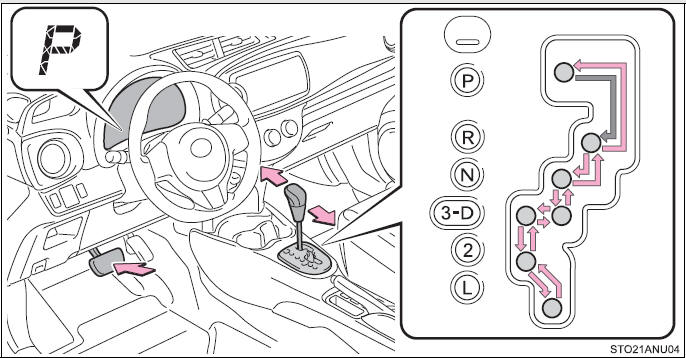

While the engine switch is in the “ON” position, move the shift lever with the brake pedal depressed. When shifting the shift lever between P and D, make sure that the vehicle is completely stopped.
■ Shift position purpose
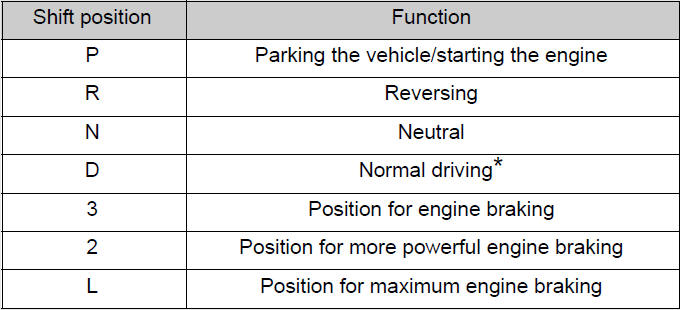
Shifting to the D position selects the most suitable gear for the particular driving condition. Setting the shift lever in the D position is recommended for normal driving.
■Downshift restriction
The maximum allowable speeds are as follows.

■AI-SHIFT
AI-SHIFT automatically selects the suitable gear according to driver performance and driving conditions. AI-SHIFT automatically operates when the shift lever is in the D position. When driving downhill, there may be cases where the vehicle shifts down automatically to obtain engine braking. As a result of the downshifting, the engine speed may increase.
■When driving with the cruise control system (if equipped)
Engine braking will not occur when downshifting from D. (→P. 158)
■If the shift lever cannot be shifted from P
→P. 328
CAUTION
■When driving on slippery road surfaces
Do not accelerate or shift gears suddenly. Sudden changes in engine braking may cause the vehicle to spin or skid, resulting in an accident.
 Engine (ignition) switch
■ Starting the engine
Vehicles with an automatic transmission
Check that the parking brake is set.
Check that the shift lever is set in P.
Firmly depress the brake pedal.
Turn the ...
 Manual transmission
■ Shifting the shift lever
Fully depress the clutch pedal before operating the shift lever, and then release
it slowly. If it is difficult to shift in reverse, shift the shift lever to N, r ...
See also:
Air conditioning system
Vehicles without an air conditioning on/off button
Vehicles with an air conditioning on/off button
Adjusting the settings
To adjust the fan speed, turn the fan speed control dial clockwise (i ...
Front sidemember reinforcement (CUT-P)
REPLACEMENT
With the radiator support removed.
REMOVAL
INSTALLATION
Temporarily install the new parts and measure each part of the new parts in accordance
with the body dimension diagram. ...
Front seats
Driver’s seat
Seat position adjustment lever
Seatback angle adjustment lever
Vertical height adjustment lever (if equipped)
Vertical height adjustment lever (if equipped) ...