
 Toyota Yaris: Manual transmission
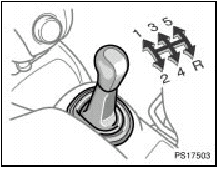
The shift pattern is conventional as shown above.
Press the clutch pedal down fully while shifting, and then release it slowly. Do not rest your foot on the pedal while driving, because it will cause clutch trouble. Do not use the clutch to hold the vehicle when stopped on an uphill grade—use the parking brake.
Recommended shifting speeds
The transmission is fully synchronized and upshifting or downshifting is easy.
For the best compromise between fuel economy and vehicle performance, you should upshift or downshift at the following speeds:
Low altitude.
—1219 m (4000 ft.) or lower gear km/h (mph).
1 to 2 or 2 to 1 24 (15).
2 to 3 or 3 to 2 40 (25).
3 to 4 or 4 to 3 64 (40).
4 to 5 / 5 to 4 72/64 (45/40).
High altitude.
—Higher than 1219 m (4000 ft.).
Upshifting.
gear km/h (mph).
1 to 2 24 (15).
2 to 3 64 (40).
3 to 4 75 (47).
4 to 5 87 (54).
Downshifting.
gear km/h (mph).
2 to 1 24 (15).
3 to 2 40 (25).
4 to 3 64 (40).
5 to 4 64 (40).
Downshift to the appropriate gear if acceleration is needed when you are cruising below the above downshifting speeds.
Upshifting too soon or downshifting too late will cause lugging, and possibly pinging.
Regularly revving the engine to maximum speed in each gear will cause excessive engine wear and high fuel consumption.
Maximum allowable speeds
To get on a highway or to pass slower traffic, maximum acceleration may be necessary.
Make sure you observe the following maximum allowable speeds in each gear: gear km/h (mph).
1 51 (31).
2 95 (59).
3 139 (86).
NOTICE.
Do not downshift if you are going faster than the maximum allowable speed for the next lower gear.
Good driving practice
- If it is difficult to shift into reverse, put the transmission in neutral, release the clutch pedal momentarily, and then try again.
- When towing a trailer, in order to maintain engine braking efficiency, do not use fifth gear.
CAUTION.
Be careful when downshifting on a slippery surface. Abrupt shifting could cause the vehicle to skid or spin.
NOTICE.
Do not use any gears other than first gear when starting off and moving forward. Doing so may damage the clutch.
Make sure the vehicle is completely stopped before shifting into reverse.
 Automatic transmission
Your automatic transmission has a shift lock system to minimize the possibility
of incorrect operation. This means you can only shift out of “P” position when the
brake pedal is depressed (w ...
 Parking brake
Type A
Type B
When parking, firmly apply the parking brake to avoid inadvertent creeping.
To set: Pull up the lever. For better holding power, first depress the brake
pedal and hold it ...
See also:
Essential information
Installing towing eyelet
Type A
Remove the eyelet cover using a flathead screwdriver.
To protect the bodywork, place a rag between the screwdriver and the vehicle
body as shown in the illustrat ...
Tire information
Typical tire symbols
Full-size tire
Compact spare tire
Tire size
DOT and Tire Identification Number
(TIN)
Location of treadwear indicators
Tire ply composition and materials
Plies are ...
Audio system operating hints
NOTICE.
To ensure correct audio system operations: Be careful not to spill beverages
over the audio system.
Do not put anything other than a Compact Disc into the slot.
The use of a cellular phon ...