
Toyota RAV4: Maintenance and care - Tires
Checking tires Toyota RAV4 hybrid
Inspect every tire to determine whether the treadwear indicators have become visible. These indicators show when the tread has worn to the point at which tire replacement is required.
Also examine the tread for uneven wear, including excessive wear along one shoulder, in the center, or across isolated areas. Irregular wear may indicate that the tire or vehicle requires further inspection.
Inspect the spare tire for visible damage and correct inflation pressure when it is not included in the regular tire rotation. A spare tire that is rarely used can still lose pressure or deteriorate over time.
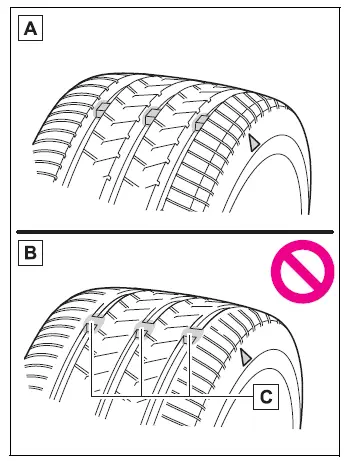
- New tread
- Worn tread
- Treadwear indicator
The locations of the treadwear indicators are identified by a “TWI”, “
 ”, or similar mark molded into the sidewall of each tire.
Replace a tire when one or more treadwear indicators are visible across the tread surface. Continuing to use a worn tire can reduce traction, especially on wet roads.
■ When to replace your vehicle’s tires
The tires on the Toyota RAV4 should be replaced under any of the following conditions:
- One or more treadwear indicators are visible on a tire.
- The tire has damage such as cuts, splits, deep cracks that expose the internal fabric, or bulges that may indicate structural damage beneath the surface.
- The tire repeatedly loses air or cannot be repaired properly because of the size, depth, or location of a puncture, cut, or other damage.
If the condition of a tire is uncertain, have it inspected by a Toyota dealer or another qualified tire specialist before continuing to drive.
■ Tire life
Any tire more than 6 years old should be examined by a qualified technician, even if it has been used only occasionally, has never been installed, or shows no obvious external damage. Tire materials can deteriorate with age regardless of remaining tread depth.
■ Maximum tire load
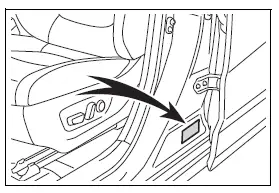
For a replacement tire, confirm that the value obtained by dividing its maximum load rating by 1.10 is greater than one-half of the higher Gross Axle Weight Rating (GAWR) for the front or rear axle.
Refer to the Certification Regulation Label for the applicable GAWR. The tire’s maximum load rating at maximum cold inflation pressure is printed on the tire sidewall.
■ Tire types
- Summer tires
Summer tires are performance-oriented tires intended primarily for highway use in dry conditions. They do not provide the same traction on snow or ice as snow tires and are therefore unsuitable for winter roads covered with snow or ice. When winter driving conditions are expected, snow tires are recommended. Install snow tires on all four wheels to maintain balanced traction and handling. - All-season tires
All-season tires are designed to provide improved traction in light snow and acceptable performance in many winter conditions while remaining suitable for year-round use. However, they do not match the traction of dedicated snow tires in deep, loose, or heavily packed snow. Their acceleration and handling performance on dry highways may also be lower than that of summer tires. - Snow tires
Snow tires are recommended when the Toyota RAV4 will be driven regularly on snow-covered or icy roads. Select tires with the same size, construction, and load capacity as the originally installed tires. Because the vehicle is originally equipped with radial tires, replacement snow tires must also use radial construction.Before installing studded tires, check all applicable local regulations because their use may be restricted. Snow tires should be installed on all four wheels rather than on only one axle.
■ If the tread on snow tires wears below 0.16 in. (4 mm)
Once snow tire tread depth falls below 0.16 in. (4 mm), the tire no longer provides its intended effectiveness as a snow tire and should not be relied upon for winter traction.
WARNING
■ When inspecting or replacing tires
Follow the precautions below to help prevent loss of control, tire failure, and accidents.
Failure to observe these requirements can damage drivetrain components and create unsafe handling characteristics. This may lead to a collision resulting in death or serious injury.
- Do not combine tires from different manufacturers or tires with different models or tread patterns.
Also avoid using tires with substantially different amounts of treadwear on the same vehicle.
- Do not install tire sizes other than those recommended by Toyota for the vehicle.
- Do not mix tires with different types of construction, including radial, bias-belted, and bias-ply tires.
- Do not combine summer, all-season, and snow tires on the Toyota RAV4.
- Do not install tires that were previously used on another vehicle.
Avoid any used tire when its previous service history, operating conditions, or repairs are unknown.
- Vehicles equipped with a compact spare tire: Do not tow a trailer or any other load while the compact spare tire is installed.
- Vehicles equipped with an emergency tire puncture repair kit: Do not tow anything while a tire repaired with the emergency puncture repair kit is installed. Additional towing load may place excessive stress on the repaired tire and cause unexpected damage or failure.
NOTICE
■ Driving on rough roads
Use additional care when driving over potholes, broken pavement, gravel, or other loose and uneven road surfaces.
Hard impacts and rough surfaces can cause a loss of tire inflation pressure and reduce the tire’s ability to absorb road shocks. They can also damage the tire sidewalls, tread, wheels, suspension-related areas, or vehicle body.
■ If the inflation pressure of any tire becomes low while driving
Do not continue driving with a significantly underinflated tire. Continued operation can destroy the tire, deform or damage the wheel, and make the vehicle more difficult to control.
Tire rotation Toyota RAV4 hybrid
Rotate the tires in the sequence shown in the illustration.
To promote even tread wear and help extend overall tire life, Toyota recommends rotating the tires whenever the scheduled tire inspection is performed. Regular rotation helps distribute wear more evenly among all four tire positions.
After rotating the tires, be sure to initialize the tire pressure warning system so that the system can recognize the updated tire positions and monitor inflation pressure correctly.
(if equipped)
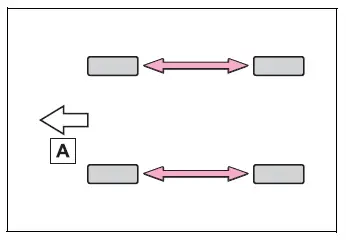
- Front
■ When rotating the tires (vehicles with tire pressure warning system)
Make sure the engine switch is OFF before rotating the tires. If the tire positions are changed while the engine switch is in ON, the stored tire-position information may not update correctly. If this occurs accidentally, turn the engine switch OFF and then back to ON, or initialize the tire pressure warning system after confirming that every tire has been adjusted to the correct inflation pressure.
Tire pressure warning system (if equipped)
The Toyota RAV4 may be equipped with a tire pressure warning system that uses pressure warning valves and transmitters installed in the wheels. The system monitors tire inflation pressure and alerts the driver when pressure falls below a predetermined level, helping identify an underinflated tire before it causes a more serious problem.
- If the inflation pressure of a tire drops below the specified warning threshold, the driver is notified through a message on the display and illumination of the tire pressure warning light.
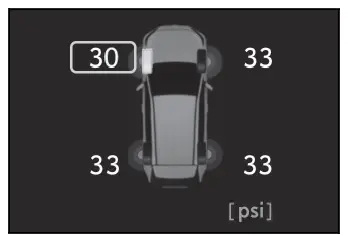
- The inflation pressure detected for each tire can be viewed on the multi-information display, allowing the driver to monitor individual tire readings.
The illustrations below are provided as examples. The layout, graphics, and displayed information may differ from what appears on the actual multi-information display, depending on the vehicle specification and display type.
With 7-inch display:
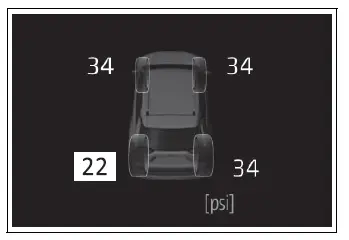
With 12.3-inch display:
■ Routine tire inflation pressure checks
The tire pressure warning system is not a substitute for regular manual pressure checks. Inspect the inflation pressure of every tire as part of routine vehicle care, using an accurate tire pressure gauge and following the specified cold-tire pressure values.
■ Tire inflation pressure
- After the engine switch is turned to ON, several minutes may be required before the current tire inflation pressures appear on the multi-information display. A similar delay may occur after the pressure in one or more tires has been adjusted.
- Tire inflation pressure varies as tire temperature changes. For this reason, the values shown on the display may differ slightly from readings obtained with a tire pressure gauge at another time or under different temperature conditions.
■ Situations in which the tire pressure warning system may not operate properly
- Under the following conditions, the tire pressure warning system may not provide accurate information or may not operate as intended:
- If wheels other than genuine Toyota wheels are installed.
- If a tire is replaced with one that does not meet the original equipment specifications.
- If a replacement tire is not the specified size for the Toyota RAV4.
- If tire chains or similar equipment are installed.
- If an auxiliary-supported run-flat tire is fitted.
- If window tint or another material that interferes with radio-wave signals has been installed.
- If a large amount of snow or ice has accumulated on the vehicle, particularly around the wheels or inside the wheel housings.
- If tire inflation pressure is significantly higher than the specified value.
- If wheels without tire pressure warning valves and transmitters are used.
- If the identification codes of the tire pressure warning valves and transmitters have not been registered in the tire pressure warning computer.
- System performance may also be temporarily affected in the following environments or situations:
- Near a television tower, electrical power plant, gas station, radio station, large electronic display, airport, or another location that produces strong radio waves or electrical interference.
- When a portable radio, mobile phone, cordless telephone, or another wireless communication device is being carried or operated near the vehicle.
If the tire-position information is not shown correctly because of radio-wave interference, the display may return to normal after the Toyota RAV4 is driven away from the affected area and the signal conditions change.
- When the vehicle is parked, the system may require additional time before a warning appears or before an existing warning is cleared.
- If tire pressure falls very rapidly, such as when a tire suddenly bursts, the warning system may not provide an alert before the pressure loss becomes severe.
■ Warning performance of the tire pressure warning system
The warning threshold used by the tire pressure warning system depends on the conditions and inflation pressures recorded during initialization. As a result, a warning may appear before the pressure becomes extremely low, or it may appear even when the current pressure is higher than the pressure originally set during initialization. Correct adjustment and initialization are therefore important whenever tire pressure or tire positions are changed.
Installing tire pressure warning valves and transmitters Toyota RAV4 compact crossover
Whenever tires or wheels are replaced on the Toyota RAV4, tire pressure warning valves and transmitters must also be installed correctly.
After new tire pressure warning valves and transmitters are fitted, their identification codes must be registered in the tire pressure warning computer. The tire pressure warning system must then be initialized so it can recognize the newly installed components and monitor tire inflation pressure properly.
■ When replacing the tires and wheels
If the ID code of a tire pressure warning valve and transmitter has not been registered, the tire pressure warning system will not function correctly. After the vehicle has been driven for approximately 20 minutes, the tire pressure warning light will blink for 1 minute and then remain illuminated, indicating a system malfunction.
NOTICE
■ Repairing or replacing tires, wheels, tire pressure warning valves, transmitters, and tire valve caps
- When removing or installing wheels, tires, tire pressure warning valves, or transmitters, contact a Toyota dealer. These precision components can be damaged if they are handled, removed, or installed incorrectly.
- Always reinstall the tire valve caps securely. Without the caps, water, dirt, and other contaminants may enter the tire pressure warning valves and cause the internal valve components to stick or operate incorrectly.
- When replacing a tire valve cap, use only a cap of the specified type.
An unsuitable valve cap may become stuck on the valve stem or interfere with proper removal.
■ To avoid damage to the tire pressure warning valves and transmitters (vehicles without spare tire)
If a tire is repaired using liquid sealant, the tire pressure warning valve and transmitter may no longer operate correctly. Contact a Toyota dealer as soon as possible after sealant has been used. When the tire is permanently repaired or replaced, make sure the affected tire pressure warning valve and transmitter are also replaced as required.
Initializing the tire pressure warning system (if equipped)
■ The tire pressure warning system must be initialized in the following circumstances:
- After rotating the tires.
- After replacing or changing a tire.
- After registering new tire pressure warning valve and transmitter ID codes.
During initialization, the current tire inflation pressures are recorded as the reference values used by the system. Correct pressure adjustment is therefore essential before beginning the procedure.
■ How to initialize the tire pressure warning system (with 7-inch display)
1. Park the Toyota RAV4 in a safe location and leave the engine stopped for at least 20 minutes.
The initialization procedure cannot be started while the vehicle is moving.
2. Adjust each tire to the specified cold tire inflation pressure.
Confirm that all tires are set accurately to the specified cold pressure before continuing. The tire pressure warning system will use these values as its operating reference after initialization.
3. Start the engine.
4. Press
 or
or
 on the steering-wheel meter control switches, and select
 .
.
5. Press
 or
or
 on the meter control switches to highlight “Vehicle Settings”, and then press and hold
 .
.
6. Press
 or
or
 on the meter control switches, select “TPWS”, and then press
 .
.
7. Press
 or
or
 on the meter control switches, and select “Set Pressure”. Then press and hold
 .
.
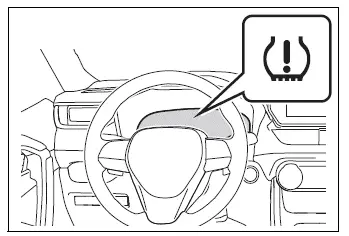
“Setting Tire Pressure Warning System” will appear on the multi-information display, and the tire pressure warning light will blink 3 times to indicate that initialization has started.
When this message disappears from the display, the initial setting procedure has been accepted.
While the tire pressure warning system is determining the position of each wheel, a message will remain visible on the multi-information display. During this process, “--” will be shown instead of the inflation pressure for each tire.
8. Drive the Toyota RAV4 primarily in a straight direction, with occasional left and right turns, at approximately 25 mph (40 km/h) or higher for about 10 to 30 minutes.
Once initialization is complete, the detected inflation pressure for each tire will appear on the multi-information display.
Initialization may still be completed when the vehicle is driven below approximately 25 mph (40 km/h), although a longer driving period may be required before the tire positions and pressure readings are recognized.
If initialization has not been completed after driving for 1 hour or longer, park the Toyota RAV4 in a safe location for approximately 20 minutes. After the waiting period, drive the vehicle again under the conditions described above.
■ How to initialize the tire pressure warning system (with 12.3-inch display)
1. Park the vehicle in a safe location, turn off the engine, and leave the Toyota RAV4 stationary for at least 20 minutes before starting the procedure.
The tire pressure warning system cannot be initialized while the vehicle is moving.
2. Adjust the inflation pressure of every tire to the specified cold tire inflation pressure.
Check each tire carefully before continuing, as the tire pressure warning system will record the current cold inflation pressures and use them as the reference values for future warnings.
3. Start the engine.
4. Press and hold
 to display the cursor in the center content display area of the multi-information display.
5. Press
 or
or
 to select
 and then press
 .
.
6. Press
 or
or
 on the meter control switches, select “
 Vehicle Settings”, and then press and hold
 .
.
7. Press
 or
or
 on the meter control switches, select “TPWS”, and then press
 .
.
8. Press
 or
or
 on the meter control switches, and select “Set Pressure”. Then press and hold
 .
.
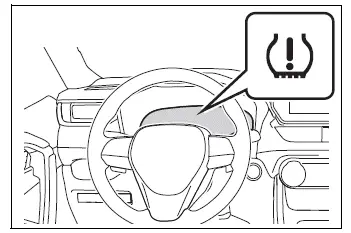
“Setting Tire Pressure Warning System” will appear on the multi-information display, and the tire pressure warning light will blink 3 times to confirm that the initialization process has started.
When this message disappears, the initial setting procedure has been accepted and the system will begin identifying the position of each tire.
While the tire pressure warning system is determining the wheel positions, a message will remain visible on the multi-information display. During this stage, “--” will appear instead of the inflation pressure reading for each tire.
9. Drive the Toyota RAV4 mainly in a straight direction, making occasional left and right turns, at approximately 25 mph (40 km/h) or higher for about 10 to 30 minutes.
When initialization is complete, the inflation pressure detected for each tire will appear on the multi-information display.
Initialization may still be completed if the vehicle is driven below approximately 25 mph (40 km/h), although the Toyota RAV4 may need to be driven for a longer period before the tire positions are identified.
If initialization is still incomplete after driving for 1 hour or longer, park the vehicle in a safe location for approximately 20 minutes. After this waiting period, drive the Toyota RAV4 again under the recommended conditions.
■ When initializing
- Initialization is normally completed while driving at a vehicle speed of approximately 25 mph (40 km/h) or higher. Maintain safe driving conditions while the system identifies the tire positions.
- Begin initialization only after adjusting every tire to the specified inflation pressure. The tires must be cold both when the pressure is adjusted and when the initialization procedure is started.
- The tire pressure warning system can be initialized by the vehicle owner. However, the time required may vary according to vehicle speed, road conditions, driving pattern, traffic, and the surrounding environment.
■ The initialization operation
- If the engine switch is accidentally turned to OFF during initialization, there is no need to repeat the procedure from the beginning. Initialization will resume automatically the next time the engine switch is turned to ON.
- If initialization is started accidentally when it is not required, allow the tires to become cold, adjust all tire inflation pressures to the specified values, and perform the initialization procedure again.
- While the system is identifying the position of each tire and inflation pressure values are not yet shown on the multi-information display, the tire pressure warning light will illuminate if the pressure in any tire decreases sufficiently.
■ If the tire pressure warning system is not initialized properly
- Under the following conditions, initialization may require more time than usual or may not be completed. Under normal driving conditions, the Toyota RAV4 tire pressure warning system generally completes initialization within approximately 30 minutes.
- The vehicle is not driven at approximately 25 mph (40 km/h) or higher for a sufficient period.
- The vehicle is driven mainly on unpaved or uneven roads, where operating conditions may interfere with tire-position detection.
- The vehicle is driven close to other vehicles, making it difficult for the system to distinguish the tire pressure warning valves and transmitters installed on your Toyota RAV4 from those fitted to nearby vehicles.
- The vehicle is operated in heavy traffic or another environment where surrounding vehicles remain close for an extended period. In this situation, additional driving time may be needed before the system correctly identifies the valves and transmitters belonging to your vehicle.
If initialization has not been completed after driving for 1 hour or longer, park the vehicle in a safe location for approximately 20 minutes. After the waiting period, drive the Toyota RAV4 again under the recommended conditions and allow the system sufficient time to identify each tire position.
- If the vehicle is reversed while initialization is in progress, the information collected up to that point will be cleared. Perform the initialization procedure again from the beginning.
- Under either of the following conditions, initialization has not started or has not been completed correctly, and the tire pressure warning system may not operate as intended.
Check that all tires are adjusted to the specified cold inflation pressure, and then repeat the complete initialization procedure.
- When initialization is started, the tire pressure warning light does not blink 3 times as specified.
- After the vehicle has been driven for approximately 20 minutes following initialization, the tire pressure warning light blinks for about 1 minute and then remains illuminated, indicating that the system has detected a malfunction or incomplete registration.
If the inflation pressure for each tire still does not appear on the multi-information display after the procedure has been repeated, have the vehicle inspected by a Toyota dealer.
WARNING
■ When initializing the tire pressure warning system
Never initialize the tire pressure warning system before adjusting every tire to the specified cold inflation pressure. If initialization is performed using incorrect pressure values, the warning light may fail to illuminate when a tire becomes underinflated, or it may illuminate even though the actual tire pressure is within the normal range.
Registering ID codes (vehicles with tire pressure warning system) Toyota RAV4 compact crossover
Each tire pressure warning valve and transmitter has its own unique identification code. Whenever a tire pressure warning valve and transmitter is replaced, the new ID code must be registered in the tire pressure warning system so the Toyota RAV4 can recognize and monitor the corresponding tire correctly.
Use the procedure below to register the ID codes. Complete each step in the specified order and allow sufficient time for the system to identify the installed transmitters.
■ Registering procedure (with 7-inch display)
1. Park the Toyota RAV4 in a safe location, leave it stationary for approximately 20 minutes, and then start the engine.
2. Press
 or
or
 on the meter control switches, and select
 .
.
3. Press
 or
or
 on the meter control switches, select “Vehicle Settings”, and then press and hold
 .
.
4. Press
 or
or
 on the meter control switches, select “TPWS”, and then press
 .
.
5. Press
 or
or
 on the meter control switches, and select “Change Wheel”. Then press and hold
 until the tire pressure warning light slowly blinks 3 times.
The wheel-change mode will be activated and registration of the tire pressure warning valve and transmitter ID codes will begin.
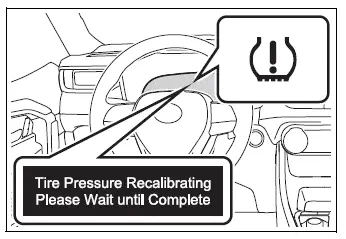
A registration message will then appear on the multi-information display to indicate that the system is searching for the transmitters.
While registration is in progress, the tire pressure warning light will blink for approximately 1 minute and then remain illuminated. During this period, “--” will be shown instead of the inflation pressure for each tire on the multi-information display.
6. Drive the Toyota RAV4 mainly in a straight direction, making occasional left and right turns, at approximately 25 mph (40 km/h) or higher for about 10 to 30 minutes.
When registration is complete, the tire pressure warning light will turn off and the detected inflation pressure for each tire will appear on the multi-information display.
Registration may still be completed when the vehicle is driven below approximately 25 mph (40 km/h), although the system may require a longer driving period to identify all tire pressure warning valves and transmitters.
If registration has not been completed after driving for 1 hour or longer, repeat the entire registration procedure from the beginning.
7. After all ID codes have been registered successfully, initialize the tire pressure warning system using the specified procedure.
■ Registering procedure (with 12.3-inch display)
1. Park the vehicle in a safe location, leave it stationary for approximately 20 minutes, and then start the engine.
2. Press and hold
 to display the cursor in the center content display area of the multi-information display.
3. Press
 or
or
 on the meter control switches to select
 and then press
 .
.
4. Press
 or
or
 on the meter control switches, select “
 Vehicle Settings”, and then press and hold
 .
.
5. Press
 or
or
 on the meter control switches, select “TPWS”, and then press
 .
.
6. Press
 or
or
 on the meter control switches, and select “Change Wheel”. Then press and hold
 until the tire pressure warning light slowly blinks 3 times.
The wheel-change setting mode will activate, and registration of the tire pressure warning valve and transmitter ID codes will begin.
A registration status message will then appear on the multi-information display.
While registration is in progress, the tire pressure warning light will blink for approximately 1 minute and then remain illuminated. During this stage, “--” will appear instead of the inflation pressure reading for each tire on the multi-information display.
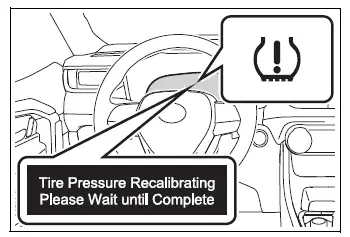
7. Drive the Toyota RAV4 mainly in a straight direction, making occasional left and right turns, at approximately 25 mph (40 km/h) or higher for about 10 to 30 minutes.
When registration is complete, the tire pressure warning light will turn off and the detected inflation pressure for each tire will appear on the multi-information display.
Registration can still be completed if the vehicle is driven below approximately 25 mph (40 km/h), although the system may require a longer driving period to identify all tire pressure warning valves and transmitters.
If registration has not been completed after driving for 1 hour or longer, repeat the entire registration procedure from the beginning.
8. After all ID codes have been registered successfully, initialize the tire pressure warning system using the specified procedure.
■ When registering ID codes
- ID code registration is normally completed while the Toyota RAV4 is driven at approximately 25 mph (40 km/h) or higher. Drive safely and allow enough time for the system to identify each transmitter.
- Before beginning registration, make sure no unused wheels equipped with tire pressure warning valves and transmitters are located near the vehicle, as nearby transmitters may interfere with correct identification.
- Always initialize the tire pressure warning system after registering the new ID codes. If initialization is performed before registration is complete, the stored reference values will be invalid and the procedure must be repeated.
- The vehicle owner can perform ID code registration, but completion time may vary depending on traffic, vehicle speed, road conditions, driving pattern, and the surrounding environment.
- The tires will be warm after the registration drive. Allow them to cool before adjusting the cold inflation pressure and initializing the tire pressure warning system.
■ Canceling ID code registration
- To cancel ID code registration after the procedure has started, turn the engine switch to OFF before driving the Toyota RAV4. If the vehicle has already been driven after registration began, repeat the ID code registration start procedure, and then switch the engine off before the vehicle is moved again.
- After ID code registration has been canceled, the tire pressure warning light will blink for approximately 1 minute when the engine switch is turned to ON and will then remain illuminated. The tire pressure warning system will become operational again when the warning light turns off.
- If the warning light remains illuminated after several minutes, the cancellation process may not have been completed correctly.
Repeat the ID code registration start procedure, and then turn the engine switch to OFF before driving the vehicle to cancel registration properly.
■ If ID codes are not registered properly
Under the conditions listed below, ID code registration may require more time than usual or may not be completed successfully. Under normal conditions, the Toyota RAV4 tire pressure warning system usually completes registration within approximately 30 minutes.
If registration is still incomplete after approximately 30 minutes of driving, continue driving for a while under suitable conditions so the system has additional time to identify the tire pressure warning valves and transmitters.
- The vehicle was not parked for approximately 20 minutes or longer before driving.
- The vehicle is not driven at approximately 25 mph (40 km/h) or higher for a sufficient period.
- The vehicle is driven mainly on unpaved or uneven roads.
- The Toyota RAV4 is driven close to other vehicles, preventing the system from clearly distinguishing its tire pressure warning valves and transmitters from those installed on nearby vehicles.
- A wheel equipped with a tire pressure warning valve and transmitter is stored inside the vehicle or positioned nearby during registration.
If ID code registration has not been completed after driving for 1 hour or longer, repeat the entire registration procedure from the beginning.
- If the vehicle is reversed while registration is in progress, the information collected up to that point will be cleared. Restart the registration procedure from the first step.
- In either of the following situations, ID code registration has not started or has not been completed correctly, and the tire pressure warning system may not operate as intended.
Check the procedure carefully and perform ID code registration again.
- When registration is started, the tire pressure warning light does not slowly blink 3 times as specified.
- After the vehicle has been driven for approximately 20 minutes following registration, the tire pressure warning light blinks for about 1 minute and then remains illuminated.
If the ID codes still cannot be registered after the procedure has been repeated correctly, contact a Toyota dealer to have the Toyota RAV4 tire pressure warning system inspected.