
Toyota RAV4: Maintenance and care - Tire inflation pressure
Always maintain the correct tire inflation pressure for the Toyota RAV4. Properly inflated tires support predictable handling, efficient operation, even tread wear, and dependable braking performance.
Check tire inflation pressure at least once each month. However, Toyota recommends performing this inspection every two weeks so that gradual pressure loss can be identified and corrected before it affects vehicle performance or tire condition.
Checking the specified tire inflation pressure
The recommended cold tire inflation pressure and the approved tire size are printed on the tire and loading information label. Use the values shown on the label installed on your Toyota RAV4 rather than relying on the maximum pressure marked on the tire sidewall.
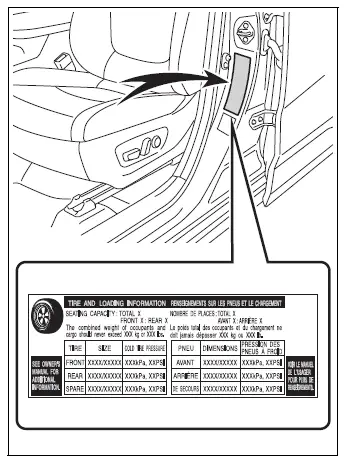
Inspection and adjustment procedure
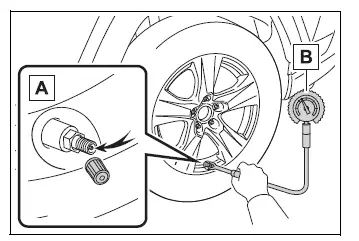
- Tire valve
- Tire pressure gauge
1. Remove the tire valve cap and place it in a clean location where it will not be lost or contaminated.
2. Press the tip of the tire pressure gauge firmly and evenly against the tire valve. Make sure the connection is sealed so that air does not escape while the reading is taken.
3. Read the tire inflation pressure using the graduations or display on the gauge.
4. If the measured pressure does not match the recommended cold inflation pressure, add air until the correct value is reached. If too much air has been added, press the center of the valve carefully to release a small amount, then measure the pressure again.
5. After measuring and adjusting the pressure, apply soapy water around the valve and check for bubbles that could indicate an air leak.
6. Reinstall the tire valve cap securely to protect the valve from dirt, water, and other contaminants.
■ Tire inflation pressure check interval
Check the inflation pressure of every tire approximately once every two weeks, or at minimum once each month. Additional checks are advisable before long journeys or when a tire appears lower than the others.
Do not overlook the spare tire. A spare that remains stored for a long period can gradually lose pressure even when it has not been used.
■ Effects of incorrect tire inflation pressure
Driving the Toyota RAV4 with tire pressure above or below the specified level can lead to the following conditions:
- Reduced fuel economy caused by increased rolling resistance or inefficient tire contact with the road.
- Reduced ride comfort, less predictable steering response, and poorer handling.
- Shortened tire life due to accelerated or irregular tread wear.
- Reduced safety, particularly during braking, cornering, or emergency maneuvers.
- Additional stress or damage to drivetrain-related components.
If any tire requires frequent inflation, have it inspected by a Toyota dealer or qualified tire specialist. Repeated pressure loss may indicate a puncture, damaged valve, poor seal, or another condition requiring repair.
■ Instructions for checking tire inflation pressure
Observe the following precautions whenever tire inflation pressure is inspected or adjusted:
- Measure tire pressure only when the tires are cold.
A cold reading is generally obtained when the vehicle has been parked for at least 3 hours or has been driven for no more than 1 mile (1.5 km). Checking under these conditions provides a more accurate comparison with the specified pressure.
- Always use a reliable tire pressure gauge.
A tire can appear properly inflated even when its actual pressure is too low or too high, so visual inspection alone is not sufficient.
- Tire pressure normally increases after driving because heat builds up inside the tire. Do not release air from a warm tire simply because the reading is higher than the specified cold pressure.
- Never exceed the vehicle capacity weight. Distribute passengers and luggage as evenly as practical so that excessive load is not concentrated on one axle or side of the vehicle.
WARNING
■ Proper inflation is essential for maintaining tire performance
Keep all tires inflated to the specified pressure.
Incorrect tire inflation can create any of the conditions listed below and may lead to loss of control, tire failure, or an accident resulting in death or serious injury:
- Rapid or excessive tread wear
- Uneven wear across the tread surface
- Unstable handling or reduced steering control
- Tire overheating that may result in a blowout
- Air leakage between the tire bead and wheel
- Wheel deformation and/or structural tire damage
- A greater risk of damage from potholes, road debris, expansion joints, sharp edges, and other road hazards
NOTICE
■ When inspecting and adjusting tire inflation pressure
Always reinstall each tire valve cap after the pressure has been checked or adjusted.
If a valve cap is missing or left loose, dirt and moisture can enter the valve and interfere with its seal. This may cause a gradual air leak and reduce the tire inflation pressure over time.