
Toyota RAV4: When trouble arises - Essential information
Emergency flashers Toyota RAV4 compact crossover
The emergency flashers are designed to warn surrounding drivers when the Toyota RAV4 must be stopped on or near the roadway because of a breakdown, collision, or another unexpected situation. Activating them makes all turn signal lights flash simultaneously, helping other road users notice the stationary vehicle and approach with greater caution.
Operating instructions
Press the emergency flasher switch to activate the system.
All turn signal lights will begin flashing at the same time, providing a clear visual warning to vehicles approaching from the front, rear, or sides.
To turn the emergency flashers off, press the switch once again. Confirm that the turn signal lights have stopped flashing before continuing to drive.
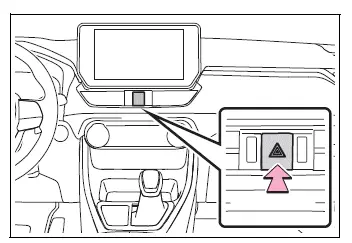
■ Emergency flashers
- If the emergency flashers are operated for an extended period while the engine is not running, the battery may gradually discharge. Avoid leaving them on longer than necessary, especially when the Toyota RAV4 has already been moved to a secure location.
- If any of the SRS airbags deploy or the vehicle experiences a strong rear impact, the emergency flashers will turn on automatically to alert nearby road users.
The emergency flashers will switch off automatically after operating for approximately 20 minutes. To turn them off manually, press the emergency flasher switch twice. Depending on the force of the impact and the specific collision conditions, the emergency flashers may not activate automatically.
If your vehicle has to be stopped in an emergency Toyota RAV4 2026
Use the following procedure only during a genuine emergency, such as when the Toyota RAV4 cannot be stopped through normal braking and operating methods. Remain calm, maintain control of the steering wheel, and reduce vehicle speed as steadily as the situation allows.
Stopping the vehicle
1. Place both feet firmly on the brake pedal and apply steady, continuous pressure.
Do not repeatedly pump the brake pedal. Pumping the pedal can increase the amount of force required to slow the vehicle and may make it more difficult to maintain consistent braking pressure.
2. Shift the shift lever to N.
If the shift lever is shifted to N
3. After the vehicle has slowed sufficiently, carefully guide it to a safe place at the side of the road and bring it to a complete stop.
4. Stop the engine only after the vehicle is safely positioned and no longer moving.
If the shift lever cannot be shifted to N
3. Continue pressing the brake pedal firmly with both feet to reduce the vehicle speed as much as possible. Keep the vehicle under control and steer toward the safest available stopping area.
4. Perform the appropriate procedure below to stop the engine while continuing to apply the brakes.
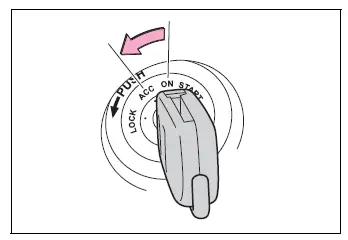
Vehicles without smart key system
Turn the engine switch to ACC. Carry out this action carefully while maintaining firm braking pressure and control of the steering wheel.
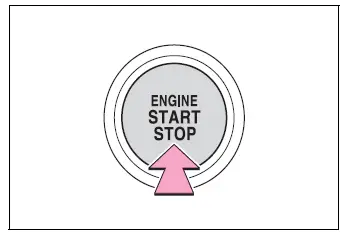
Vehicles with smart key system
Press and hold the engine switch continuously for 2 seconds or more, or press it briefly 3 times or more in rapid succession. Continue braking throughout the procedure and prepare for the steering and brake controls to require greater physical effort after the engine stops.
5. Bring the Toyota RAV4 to a complete stop in a safe place at the side of the road, away from moving traffic whenever conditions permit.
WARNING
■ If the engine has to be turned off while driving
- Turning off the engine while the vehicle is moving will cause the power assistance for the brakes and steering wheel to be lost. As a result, the brake pedal will become harder to depress and the steering wheel will require considerably more effort to turn. Reduce the vehicle speed as much as possible before stopping the engine.
- Vehicles without smart key system: Never attempt to remove the key while the vehicle is moving. Removing it may cause the steering wheel to lock, making it impossible to steer the vehicle safely.
If the vehicle is submerged or water on the road is rising Toyota RAV4 2026
The Toyota RAV4 is not designed to travel through deeply flooded roads or areas where water is rapidly rising. Never enter a roadway that may be submerged, even if the depth appears manageable. If there is a risk that the vehicle could become flooded or carried away by moving water, remaining inside may be extremely dangerous. Stay calm, assess the available escape routes, and follow the steps below without unnecessary delay.
- If a door can be opened safely, open it immediately and exit the vehicle. Move away from the flooded area as soon as conditions allow.
- If the doors cannot be opened, use the power window switch to lower a window and establish a clear escape route before the water rises further.
- If a window opens, carefully leave the Toyota RAV4 through the window and move toward a safe location.
- If neither the doors nor the windows can be opened because of rising water, remain calm. Wait until the water level inside the vehicle rises enough for the pressure inside and outside the vehicle to become approximately equal. After sufficient water has entered the cabin and the pressure difference has decreased, attempt to open a door and exit the vehicle.
When the outside water level rises above approximately half the height of a door, pressure from the surrounding water may prevent the door from being opened from inside the vehicle.
■ Water level exceeds the floor
If water rises above the floor and remains there, electrical equipment may become damaged. The power windows may stop operating, the engine may shut down, and the Toyota RAV4 may no longer be able to move. Because these conditions can develop quickly, establish an escape route before the water reaches critical electrical components.
■ Using an emergency escape hammer*
The windshield is made of laminated glass, which cannot normally be shattered with an emergency escape hammer*. The other vehicle windows use tempered glass, which is the type of glass intended for use with an appropriate emergency escape tool.
*: Contact your Toyota dealer or the manufacturer of an aftermarket accessory for additional information about selecting and correctly using an emergency escape hammer.
WARNING
■ Caution while driving
Do not drive on roads that may be submerged or where the water level is rising. Entering flooded areas can damage the vehicle, cause it to become immobilized, allow water to enter the cabin, or result in the vehicle being carried away by moving water. Any of these situations may lead to serious injury or death.
If your vehicle needs to be towed Toyota RAV4 compact crossover
If towing becomes necessary, Toyota recommends having your Toyota RAV4 transported by an authorized Toyota dealer or a qualified commercial towing service. A wheel-lift truck or flatbed truck should be used to move the vehicle safely and reduce the risk of damage.
Always use an appropriate safety chain system during towing and comply with all applicable state, provincial, and local towing laws. Proper securing procedures are essential to keep the vehicle stable throughout transportation.
Situations when it is necessary to contact dealers before towing (vehicles with towing eyelet)
The following conditions may indicate a problem with the transmission or another part of the drivetrain.
Contact your Toyota dealer or a professional commercial towing service before attempting to tow the vehicle. Continuing without a proper inspection could cause additional damage.
- The engine is running, but the vehicle does not move when a drive position is selected.
- The vehicle produces an unusual or abnormal sound while running or when an attempt is made to move it.
Towing with a wheel-lift type truck
From the front (2WD models)
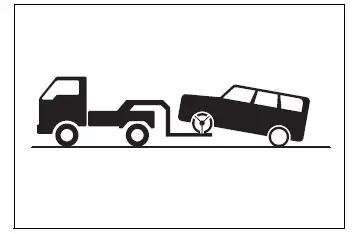
Release the parking brake before the Toyota RAV4 is transported from the front.
Turn automatic mode off so that the parking brake does not engage unexpectedly during the towing procedure.
From the front (AWD models)
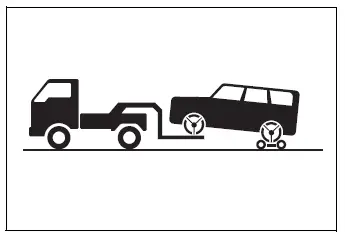
Place a towing dolly securely under the rear wheels so that they do not remain in contact with the road while the vehicle is being transported.
From the rear
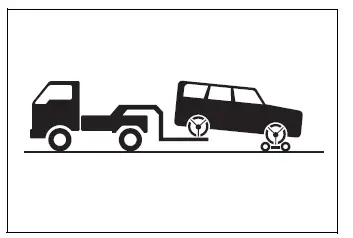
Use a towing dolly under the front wheels to prevent them from rotating on the road and to protect the drivetrain and steering components.
WARNING
Observe all of the following precautions whenever the vehicle is being prepared for towing or transportation.
Failure to follow these instructions may result in loss of vehicle stability, serious injury, or death.
■ When towing the vehicle
2WD models
Transport the vehicle with the front wheels raised from the road or with all four wheels completely off the ground. If the Toyota RAV4 is towed while its front wheels remain in contact with the road, the drivetrain and related components may be seriously damaged.
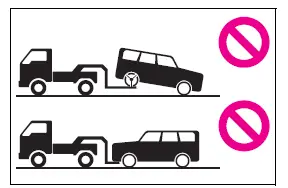
AWD models
Always transport an AWD model with all four wheels raised completely off the ground. If any tires remain in contact with the road during towing, the drivetrain or associated components may be damaged, and the vehicle could become unstable or come off the towing truck.
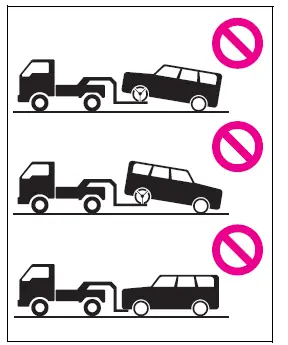
NOTICE
■ To prevent damage to the vehicle when towing using a wheel-lift type truck
- Vehicles without smart key system: Do not tow the vehicle from the rear while the engine switch is in the "LOCK" position or after the key has been removed. The steering lock mechanism is not designed to keep the front wheels securely aligned during towing.
- When one end of the vehicle is raised, verify that there is sufficient ground clearance at the opposite end. Inadequate clearance may allow the bumper, underbody, or other parts of the vehicle to contact the road and become damaged during transportation.
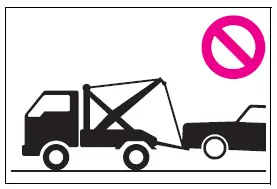
■ Towing with a sling-type truck
Do not use a sling-type towing truck for the Toyota RAV4. This towing method can place excessive pressure on the body and may damage exterior panels or underbody components.
Using a flatbed truck
When transporting the vehicle on a flatbed truck, secure the tires with suitable tire-strapping belts. Follow the flatbed truck manufacturer's owner's manual for the correct belt placement, tightening sequence, and vehicle-securing procedure.
To limit movement while the vehicle is being transported, apply the parking brake and turn the engine switch off after the Toyota RAV4 has been positioned and properly secured on the flatbed.
Emergency towing (vehicles with towing eyelet)
If a tow truck is unavailable during an emergency, the vehicle may be towed temporarily with cables or chains securely attached to the emergency towing eyelets. This method should only be used on hard-surfaced roads, for a maximum distance of 50 miles (80 km), and at a speed below 18 mph (30 km/h).
A driver must remain inside the vehicle throughout emergency towing to steer it, operate the brakes, and maintain control of its direction.
Before towing begins, confirm that the wheels, drivetrain, axles, steering, and brakes are all in suitable operating condition. Emergency towing must not be attempted if any of these components are damaged or unable to function correctly.
Emergency towing procedure (vehicles with towing eyelet)
When the Toyota RAV4 must be temporarily towed by another vehicle, the towing eyelet must first be installed correctly. Follow the procedure below carefully to prepare the vehicle and establish a secure towing connection.
1. Remove the wheel nut wrench and towing eyelet from their storage locations.
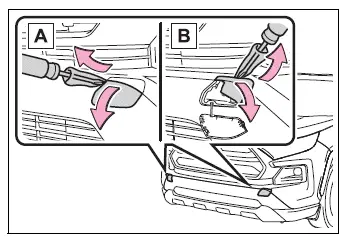
2. Using a flathead screwdriver, carefully remove eyelet cover (A), followed by eyelet cover (B).
To protect the paint and surrounding bodywork from scratches, place a clean cloth between the screwdriver and the vehicle body, as shown in the illustration. Apply only enough pressure to release each cover.
Type A
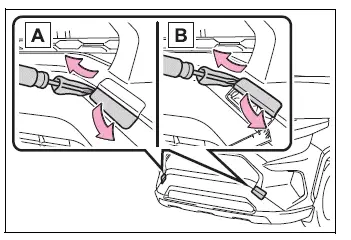
Type B
3. Insert the towing eyelet into the exposed mounting hole and turn it by hand until it is partially tightened. Make sure the threads engage correctly and do not force the eyelet if it does not turn smoothly.
Type A
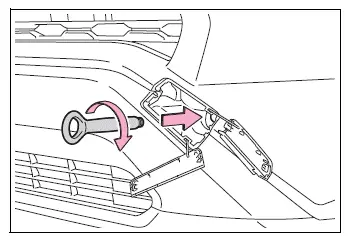
Type B
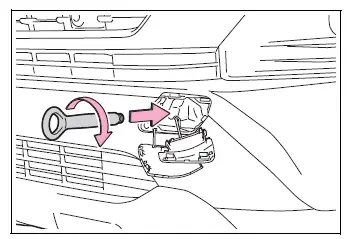
4. Using the wheel nut wrench or a suitable hard metal bar, tighten the towing eyelet securely. Confirm that it is fully seated and does not move within the mounting hole.
Type A
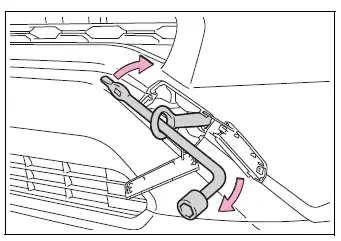
Type B
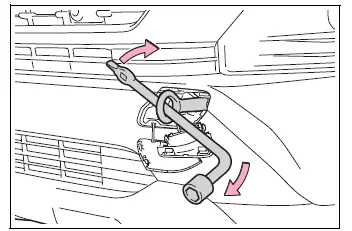
5. Attach the towing cables or chains securely to the installed towing eyelet.
Position the cables or chains carefully so they do not rub against, strike, or otherwise damage the Toyota RAV4 body during towing.
6. Enter the vehicle that will be towed and start the engine.
Turn off the Parking Support Brake function, if the vehicle is equipped with this feature.
If the engine cannot be started, turn the engine switch to ON so the necessary vehicle controls can be operated.
Vehicles with Stop & Start system: Before towing begins, turn the engine switch to OFF once, and then start the engine as specified.
7. Shift the shift lever to N and release the parking brake.
Turn the automatic parking brake mode off before the vehicle begins moving.
■ While towing
If the engine is not running, power assistance for the brakes and steering will not operate. The brake pedal will require greater pressure, and the steering wheel will be considerably harder to turn, so the driver must be prepared for the increased effort.
■ Wheel nut wrench
- Vehicles without a spare tire: The wheel nut wrench is stored in the luggage compartment.
- Vehicles with a spare tire: The wheel nut wrench is stored inside the tool bag in the luggage compartment.
WARNING
Observe all of the following precautions when preparing or towing the vehicle.
Failure to follow these instructions may result in death or serious injury.
■ While towing
- When towing with cables or chains, avoid sudden starts, abrupt acceleration, and other actions that could place excessive stress on the towing eyelet or towing equipment.
Excessive force may damage or break the towing eyelet, cables, or chains. Broken components or flying debris could strike nearby people and cause serious injury or substantial property damage.
- Vehicles without smart key system: Do not turn the engine switch to the "LOCK" position while the vehicle is being towed.
Doing so may lock the steering wheel, making it impossible for the driver of the towed vehicle to steer safely.
■ Installing towing eyelets to the vehicle
Make sure each towing eyelet is installed and tightened securely before towing begins. An eyelet that is not properly secured may loosen or separate from the Toyota RAV4 while the vehicle is being moved.
NOTICE
■ To prevent damage to the vehicle during emergency towing
Never attach towing cables or chains to suspension components. Use only the designated towing eyelet described in this procedure.
■ When towing the vehicle (vehicles with Stop & Start system)
If the vehicle must be towed with all four wheels remaining on the ground, complete the following procedure before towing begins to help protect the Stop & Start system.
Turn the engine switch to OFF, and then start the engine. If the engine cannot be started, turn the engine switch to ON.