
Toyota RAV4: Maintenance and care - Checking and replacing fuses
If an electrical component in the Toyota RAV4 stops operating, a fuse may have blown. Inspect the corresponding fuse and replace it when necessary, following the procedure below.
Checking and replacing fuses
1. Turn the engine switch to OFF and make sure the affected electrical component is no longer operating.
2. Open the appropriate fuse box cover.
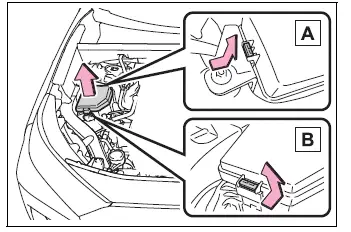
Engine compartment: Type A fuse box (if equipped)
Press claws A and B until both locks are completely released, and then lift the cover carefully. Do not pull upward while either claw remains engaged.
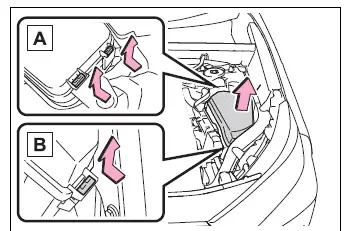
Engine compartment: Type B fuse box
Press claws A and B fully to disengage the locking points, and then raise the fuse box cover without twisting it.
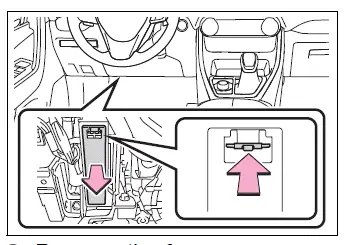
Left side instrument panel
Remove the fuse panel lid from the left side of the instrument panel, taking care not to damage its retaining tabs.
3. Remove the fuse that corresponds to the inoperative electrical component.
Only a Type A fuse can be removed with the supplied pullout tool. Grip the fuse securely and pull it straight out rather than twisting it sideways.
4. Inspect the fuse to determine whether its internal element has melted or separated.
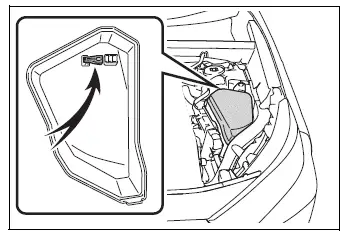
Replace a blown fuse only with a new fuse of the correct amperage rating. The required rating and fuse location are shown on the fuse box lid.
Type A
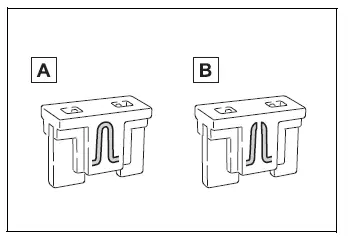
- Normal fuse
- Blown fuse
Type B
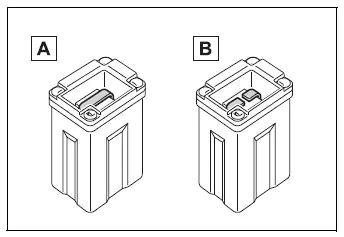
- Normal fuse
- Blown fuse
Type C
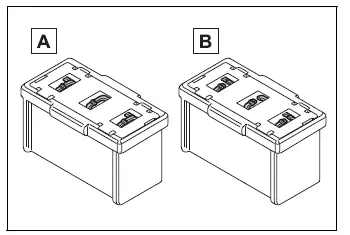
- Normal fuse
- Blown fuse
■ After a fuse is replaced
- When reinstalling a fuse box lid or cover, make sure every tab and locking point is engaged securely. A loose cover may allow moisture, dirt, or debris to enter the fuse box.
- If a light still does not illuminate after the correct fuse has been replaced, the corresponding bulb or lighting component may also require replacement.
- If the replacement fuse blows again, stop using the affected circuit and have the Toyota RAV4 inspected by a Toyota dealer. Repeated fuse failure may indicate an unresolved electrical problem.
■ If there is an overload in a circuit
A fuse is designed to melt and interrupt the circuit when excessive electrical current is detected. This protects the wiring harness and connected components from overheating or more extensive damage.
WARNING
■ To prevent system failures and vehicle fire
Follow all of the precautions below when inspecting or replacing a fuse.
Using an unsuitable replacement or modifying the fuse circuit can damage the vehicle and may result in fire, death, or serious injury.
- Never install a fuse with a higher amperage rating than specified, and never substitute metal foil, a coin, or any other object for a fuse.
- Always use a genuine Toyota fuse or an equivalent fuse of the specified type and rating.
Never bridge the fuse terminals with wire, even as a temporary repair.
- Do not alter the fuses, fuse terminals, fuse box, or related electrical wiring.
NOTICE
■ Before replacing fuses
Have the cause of the electrical overload identified and repaired by a Toyota dealer as soon as possible. Replacing a fuse without correcting the underlying fault may cause the new fuse to blow again.
NOTICE
■ To prevent damage to the engine compartment fuse box cover
Completely release all claw locks before lifting the fuse box cover. Pulling the cover upward while a claw is still engaged can bend or break the retaining section and prevent the cover from closing securely.