Toyota RAV4: Driving - Before driving
Before driving the Toyota RAV4, take a moment to confirm that the vehicle and its surroundings are ready for a safe journey. Check the area around the vehicle for people, animals, obstacles, or objects that may not be visible from the driver’s seat, and make sure all doors and the rear hatch are securely closed.
Adjust the driver’s seat, steering wheel, head restraint, and mirrors before moving the vehicle so that you can maintain a comfortable driving position and a clear view of the road. Ensure that every occupant is seated correctly and wearing a properly fastened seat belt, and secure any loose items that could shift, fall, or interfere with the controls while the Toyota RAV4 is in motion.
Before setting off, verify that the instrument panel does not display any warnings requiring attention and that the windshield, windows, lights, and mirrors provide adequate visibility. Becoming familiar with the Toyota RAV4 controls and completing these basic checks before each trip can help reduce distractions and support more confident, controlled driving.
Driving the vehicle Toyota RAV4
Follow the procedures below to operate the Toyota RAV4 safely, smoothly, and with proper control in a variety of everyday driving situations.
Driving procedure
■ Driving
1. Keep the brake pedal firmly depressed, and then move the shift lever to D.
2. Release the parking brake.
If the parking brake is operating in automatic mode, it will be released automatically when the required conditions for moving the vehicle are met.
3. Gradually release the brake pedal, check that the surrounding area is clear, and gently depress the accelerator pedal to move the Toyota RAV4 forward smoothly.
■ Stopping
1. With the shift lever remaining in D, press the brake pedal smoothly and bring the vehicle to a controlled stop.
2. Apply the parking brake when necessary. If the vehicle will remain stopped for an extended period, move the shift lever to P to prevent unintended vehicle movement.
■ Parking the vehicle
1. With the shift lever in D, keep the brake pedal fully depressed after the vehicle has come to a complete stop.
2. Set the parking brake.
Confirm that the parking brake indicator light is illuminated, indicating that the parking brake has been applied correctly.
3. Shift the shift lever to P.
4. Turn the engine switch to OFF to stop the engine.
After shifting to P, do not press the shift release button unnecessarily, as the shift position should remain securely engaged.
5. Exit and lock the vehicle, making sure that the key remains in your possession.
When parking the Toyota RAV4 on a hill or other inclined surface, block the wheels if necessary to provide additional protection against unintended movement.
■ Starting off on a steep uphill
1. Keep the brake pedal depressed, and then move the shift lever to D.
2. Pull the parking brake switch to apply the parking brake manually and hold the vehicle securely in position.
3. Release the brake pedal carefully and gently depress the accelerator pedal to begin moving uphill without abrupt acceleration.
■ When starting off on an uphill
Hill-start assist control will activate when its operating conditions are met, helping reduce backward vehicle movement as the driver transitions from the brake pedal to the accelerator pedal.
■ Driving in the rain
- Drive with increased caution during rain because visibility may be reduced, the windows may fog, and the road surface can become slippery. Maintain adequate distance from the vehicle ahead and operate the steering, accelerator, and brakes smoothly.
- Exercise particular care when rain first begins, as oil, dust, and other residue on the road may make the surface especially slippery.
- Avoid high speeds when driving the Toyota RAV4 on an expressway in heavy rain. Water may collect between the tires and road surface, reducing tire contact and preventing the steering and brakes from responding as expected.
■ Engine speed while driving
Under the following driving conditions, engine speed may temporarily increase. This occurs because the transmission automatically selects an appropriate higher or lower gear according to vehicle speed, road gradient, and driver input. This behavior does not indicate unintended or sudden acceleration.
- When the vehicle determines that it is traveling uphill or downhill
- When the accelerator pedal is released
- When the brake pedal is depressed while sport mode is selected
■ Restraining engine output (Brake Override System)
- If the accelerator and brake pedals are depressed at the same time, the Brake Override System may limit engine output to help the driver slow or stop the vehicle.
- While the system is operating, a warning message will appear on the multi-information display to inform the driver that engine output is being restrained.
■ Breaking in your new Toyota
To support the long-term performance and service life of a new Toyota RAV4, observe the following precautions during the initial driving period. Smooth acceleration, controlled braking, and varied driving speeds allow major vehicle components to settle into normal operation gradually.
- For the first 200 miles (300 km): Avoid sudden or unnecessarily hard stops whenever traffic and road conditions allow.
- For the first 500 miles (800 km): Do not tow a trailer.
- For the first 600 miles (1000 km):
- Do not operate the vehicle at extremely high speeds.
- Avoid sudden or full-throttle acceleration.
- Do not drive continuously in low gears for prolonged periods.
- Avoid maintaining one constant speed for an extended time; vary the vehicle speed gradually when conditions permit.
■ Operating your vehicle in a foreign country
Before driving the Toyota RAV4 in another country, confirm that the vehicle complies with applicable local laws, registration requirements, and traffic regulations. Become familiar with local road signs, driving practices, and any rules that differ from those in your home country before beginning the trip.
When operating the Toyota RAV4 in another country, comply with all applicable vehicle registration laws and local traffic regulations. Before traveling, also confirm that the correct type and grade of fuel specified for the vehicle will be readily available.
WARNING
Observe the following precautions.
Failure to follow these precautions may result in death or serious injury.
■ When starting the vehicle
Whenever the vehicle is stopped while the engine is running, keep your foot firmly on the brake pedal. This helps prevent the Toyota RAV4 from creeping forward or backward unexpectedly.
■ When driving the vehicle
- Do not drive until you are completely familiar with the positions and operation of the brake and accelerator pedals. Confusing the pedals can result in an immediate loss of control.
- Accidentally pressing the accelerator pedal instead of the brake pedal can cause sudden acceleration and may lead to a serious collision.
- When reversing, turning your upper body to look behind the vehicle may make it more difficult to operate the pedals accurately.
Maintain a stable seating position and make sure you can press the correct pedal smoothly throughout the maneuver.
- Maintain a proper driving posture even when moving the Toyota RAV4 only a short distance. Correct positioning allows the brake and accelerator pedals to be operated accurately and without hesitation.
- Use your right foot to operate the brake pedal. Braking with the left foot may delay your response or cause incorrect pedal operation during an emergency, increasing the risk of an accident.
- Do not drive over or stop near flammable materials such as dry leaves, paper, cloth, or rags.
The exhaust system and exhaust gases can become extremely hot. If combustible material comes into contact with these heated components, a fire may occur.
- Do not turn off the engine during normal driving. Although steering and braking control will not be lost immediately, the power assistance provided to these systems will stop.
Without power assistance, considerably more effort will be required to steer and brake. Move the vehicle off the road and stop in a safe location as soon as conditions permit.
An exception may be necessary during an emergency in which the vehicle cannot be stopped using the normal procedure.
- Use engine braking by selecting a lower gear when descending a steep hill so that the Toyota RAV4 can maintain a safe and controlled speed.
Continuous or excessive use of the brake pedal may overheat the brakes and reduce their stopping effectiveness.
- Do not adjust the steering wheel, driver’s seat, inside rearview mirror, or outside rearview mirrors while the vehicle is moving.
Attempting to make these adjustments while driving may distract you or cause a loss of vehicle control.
- Always confirm that every passenger keeps their arms, head, and all other parts of their body completely inside the vehicle while it is moving.
- Never exceed the posted speed limit or drive faster than road, traffic, weather, and tire conditions safely allow. Even where legally permitted, do not exceed 85 mph (140 km/h) unless the vehicle is fitted with tires designed for high-speed operation. Driving above 85 mph (140 km/h) with unsuitable tires may cause tire failure, loss of control, and serious injury. Consult a qualified tire dealer to verify the speed capability of the tires installed on the vehicle before driving at such speeds.
■ When driving on slippery road surfaces
- Avoid sudden braking, rapid acceleration, and abrupt steering inputs. These actions may cause the tires to lose traction and significantly reduce your ability to control the vehicle.
- Sudden acceleration, engine braking caused by shifting, or abrupt changes in engine speed may cause the vehicle to skid. Operate the accelerator, brakes, and steering smoothly to maintain stability.
- After driving through standing water or a deep puddle, lightly press the brake pedal to confirm that the brakes respond normally. Wet brake pads may reduce braking performance, increase stopping distance, or cause the brakes on one side of the vehicle to operate differently from those on the other side.
If the brakes on only one side remain wet or do not operate correctly, braking may become uneven and steering control can be affected. Drive cautiously and confirm that normal braking performance has returned before continuing at regular speed.
■ When shifting the shift lever
- Do not allow the Toyota RAV4 to roll backward while the shift lever is in a forward driving position, or to roll forward while the shift lever is in R.
Allowing the vehicle to move in the direction opposite to the selected shift position may cause the engine to stall or reduce braking and steering performance, potentially resulting in an accident or damage to the vehicle.
- Never shift the shift lever to P while the vehicle is moving.
Selecting P before the Toyota RAV4 has come to a complete stop can damage the transmission and may cause a sudden loss of vehicle control.
- Do not shift the shift lever to R while the vehicle is moving forward.
Changing to reverse before the vehicle has stopped completely can damage the transmission and may lead to a loss of control.
- Do not shift the shift lever to a forward driving position while the vehicle is moving backward.
Doing so places excessive stress on the transmission and may cause vehicle damage or an unexpected loss of control.
- Moving the shift lever to N while the vehicle is in motion disconnects the engine from the transmission.
Engine braking is unavailable when N is selected, which may make it more difficult to control vehicle speed, particularly when traveling downhill.
- Do not operate the shift lever while the accelerator pedal is depressed.
Shifting into any position other than P or N while pressing the accelerator may cause the vehicle to accelerate suddenly and unexpectedly. This can result in an accident, death, or serious injury. Incorrect shifting under these conditions may also damage the transmission and cause a loss of vehicle control.
- When the vehicle is stopped on an incline, keep the brake pedal firmly depressed and apply the parking brake securely as necessary. Do not rely on the accelerator pedal or transmission alone to prevent the Toyota RAV4 from rolling forward or backward.
- Avoid unnecessarily revving or racing the engine while the vehicle is stationary.
Operating the engine at high speed while stopped can cause the exhaust system to become extremely hot. If dry leaves, paper, cloth, or other combustible materials are nearby, the heat may create a fire hazard.
■ When the vehicle is parked
Do not leave eyeglasses, spray cans, soft drink cans, or similar objects inside the vehicle when it is parked in direct sunlight.High temperatures inside the passenger compartment may cause the following dangerous conditions:
- Gas may leak from a pressurized spray can, creating a risk of ignition or fire.
- Heat inside the vehicle may deform or crack plastic eyeglass lenses, frames, and other plastic components.
- Soft drink cans may rupture as internal pressure increases, spraying their contents throughout the Toyota RAV4 interior. Spilled liquid may also reach electrical components and cause a short circuit or other damage.
- Do not attach adhesive discs, suction-mounted decorations, or similar objects to the windshield or windows. Do not place air fresheners, bottles, or other containers on the instrument panel or dashboard. Under direct sunlight, these objects may concentrate light like a lens and potentially cause a fire inside the vehicle.
- Do not leave a door or window open when curved glass is covered with a metallized film, such as a silver-colored reflective coating. Reflected or concentrated sunlight may create excessive heat and could damage nearby materials or increase the risk of fire.
Reflected sunlight may cause the curved glass to concentrate light like a lens, generating intense heat that could ignite nearby materials and start a fire inside the vehicle.
- Whenever the Toyota RAV4 is parked, apply the parking brake securely, shift the shift lever to P, turn off the engine, and lock the vehicle.
Never leave the vehicle unattended while the engine is running.
Even when the shift lever is in P, failing to apply the parking brake may allow the vehicle to move unexpectedly under certain conditions, potentially resulting in an accident.
- Do not touch the exhaust pipes while the engine is running or immediately after the engine has been turned off.
The exhaust components may remain extremely hot and can cause serious burns.
■ When taking a nap in the vehicle
Always turn the engine off before resting or sleeping inside the Toyota RAV4. If the engine remains running, accidental movement of the shift lever or unintended pressure on the accelerator pedal could cause the vehicle to move, resulting in an accident. Prolonged idling may also cause the engine or exhaust system to overheat and create a fire hazard. In a garage, enclosed space, or other poorly ventilated area, exhaust gases may accumulate and enter the passenger compartment, potentially causing carbon monoxide poisoning, death, or a serious health emergency.
■ When braking
- When the brakes are wet, reduce your speed and drive with greater caution.
Wet brakes may increase stopping distance and can cause uneven braking between the left and right sides of the vehicle, affecting directional stability. The parking brake may also be less effective until the braking components have dried.
- If the brake booster is not operating, increase the distance between your Toyota RAV4 and the vehicle ahead, and avoid steep hills, sharp turns, or other situations that require frequent or forceful braking.
The brakes will still function, but the brake pedal must be pressed more firmly than usual and the stopping distance will be longer. Have the braking system inspected and repaired immediately.
- Do not repeatedly pump the brake pedal if the engine stalls.
Each press of the brake pedal reduces the remaining reserve of power-assisted braking, making subsequent braking more difficult.
- The brake system consists of two independent hydraulic circuits. If one circuit fails, the other can continue to provide braking force. However, the brake pedal will need to be pressed more firmly than normal, and the stopping distance will increase considerably. Reduce speed, stop in a safe location, and have the brakes repaired immediately.
■ If the vehicle becomes stuck (AWD models)
Do not spin the wheels excessively if one or more tires are raised off the ground or if the Toyota RAV4 is stuck in sand, mud, snow, or a similar surface. Excessive wheelspin may damage driveline components. It may also cause the vehicle to move suddenly forward or backward when traction is regained, creating a risk of collision or serious injury.
NOTICE
■ When driving the vehicle
- Do not press the accelerator and brake pedals at the same time while driving, as simultaneous pedal operation may cause engine output to be limited and can place unnecessary stress on vehicle components.
- Do not use the accelerator pedal, or press the accelerator and brake pedals together, to hold the vehicle stationary on a hill. Keep the brake pedal depressed and apply the parking brake as necessary to prevent the vehicle from rolling.
■ Avoiding damage to vehicle parts
-
Do not turn the steering wheel fully to either side and hold it against the stop for an extended period. Prolonged operation in this position may place excessive strain on steering components and could lead to premature wear or damage.
Holding the steering wheel at its maximum left or right position for an extended period may overheat or damage the power steering motor.
- When driving over bumps, potholes, raised surfaces, or uneven sections of road, reduce speed as much as safely possible. Passing over these obstacles too quickly may damage the wheels, tires, suspension components, or underside of the Toyota RAV4.
■ If you get a flat tire while driving
A flat, punctured, or otherwise damaged tire may cause one or more of the following conditions while the vehicle is moving:
- The Toyota RAV4 may become difficult to steer or control, particularly during braking or cornering.
- Unusual noises, repeated impacts, or strong vibrations may be felt through the body, steering wheel, or floor.
- The vehicle may lean noticeably toward the side with the damaged tire.
Grip the steering wheel firmly, avoid abrupt steering inputs, and gradually press the brake pedal to reduce speed. Move away from traffic and stop in a safe location as soon as conditions allow.
Refer to the appropriate flat-tire instructions before attempting to repair the tire, use an emergency repair kit, or replace the affected wheel.
■ When encountering flooded roads
Do not attempt to drive the Toyota RAV4 through a road that has become flooded after heavy rain, a storm, or overflowing water.
Driving through deep or fast-moving water may cause severe vehicle damage, including the following:
- The engine may stall and may not restart.
- Water may enter electrical components and cause short circuits, malfunctions, or corrosion.
- Water entering the engine may cause serious internal damage.
If the vehicle has been driven through a flooded area or has been partially submerged, have your Toyota dealer inspect the following components and operating conditions:
- Brake operation, including whether the vehicle stops evenly and responds normally.
- The quantity and condition of the oils and fluids used in the engine, transaxle, transfer unit on AWD models, rear differential on AWD models, and other applicable components.
- The lubricant condition of the propeller shaft on AWD models, bearings, suspension joints where inspection is possible, and the operation of all related joints, bearings, and driveline components.
■ When parking the vehicle
Always apply the parking brake securely and shift the shift lever to P before leaving the Toyota RAV4. Failure to complete both steps may allow the vehicle to move unexpectedly or accelerate suddenly if the accelerator pedal is pressed by mistake.
Sudden start restraint control (Drive-Start Control [DSC])
If an unusual shift operation is performed while the accelerator pedal is depressed, Drive-Start Control may limit engine output to reduce the possibility of sudden or unintended acceleration.
- When the shift lever is moved to R while the accelerator pedal is depressed.*
- When the shift lever is moved from P or R to a forward driving position, such as D, while the accelerator pedal is depressed.*
When the system activates, a message appears on the multi-information display. Read the displayed information carefully and follow the provided instructions before continuing to drive.
*: Depending on the circumstances and the operating status of the system, the requested shift position may not be selected.
■ Drive-Start Control (DSC)
- Sudden start restraint control does not operate when TRAC has been turned off. If Drive-Start Control prevents the vehicle from escaping mud, fresh snow, or another low-traction surface, TRAC may be deactivated so that the Toyota RAV4 can attempt to move free more effectively.
Sudden start restraint control will also remain inactive under the following condition:
- When Multi-terrain Select is selected on AWD models
Cargo and luggage Toyota RAV4 fifth generation
Review the following information carefully before carrying cargo or luggage in the Toyota RAV4. Proper storage, weight distribution, and compliance with the vehicle’s load limits are essential for maintaining safe handling, braking performance, and passenger protection.
WARNING
■ Things that must not be carried in the luggage compartment
The following items may create a serious fire hazard if they are stored or transported in the luggage compartment:
- Containers holding gasoline or other highly flammable fuel
- Aerosol cans, particularly those exposed to heat or possible impact
■ Storage precautions
Observe the following precautions whenever cargo or luggage is placed inside the vehicle.
Failure to store items correctly may interfere with pedal operation, obstruct the driver’s view, or allow objects to strike the driver or passengers during sudden braking, sharp steering, or a collision. Any of these situations may result in an accident, death, or serious injury.
- Place cargo and luggage in the luggage compartment whenever possible, rather than leaving loose items in the Toyota RAV4 passenger area.
- Do not stack cargo in the luggage compartment higher than the tops of the seatbacks, as elevated items may move forward during sudden braking or a collision.
- Do not place cargo, luggage, or loose objects in or on any of the following locations:
- At the driver’s feet, where an item could interfere with the brake or accelerator pedal
- On the front passenger seat or rear seats when items are stacked or left unsecured
- On the luggage cover, if equipped
- On the instrument panel
- On the dashboard, where objects may obstruct visibility or become projectiles
- Secure every item carried in the occupant compartment so that it cannot slide, roll, tip over, or be thrown forward while the vehicle is moving.
- When the rear seats are folded down, do not position long objects directly behind the front seats unless they are properly secured and cannot move forward.
- Never allow anyone to travel in the luggage compartment. This area is designed for cargo and does not provide an approved passenger seating position.
All occupants must sit in designated seats and wear their seat belts correctly. A person riding in the luggage compartment is far more likely to suffer death or serious injury during sudden braking, an abrupt maneuver, or a collision.
Capacity and distribution
The amount of cargo that can safely be carried depends on the combined weight of the driver and all passengers. As occupant weight increases, the available capacity for cargo and luggage decreases by the same amount.
(Cargo capacity) = (Total load capacity) - (Total weight of occupants)
Steps for Determining Correct Load Limit -
(1) Locate the statement, “The combined weight of occupants and cargo should never exceed XXX kg or XXX lbs.” on the vehicle placard. This figure represents the maximum combined load permitted for the Toyota RAV4.
(2) Calculate the combined weight of the driver and every passenger who will be traveling in the vehicle.
(3) Subtract the combined weight of the driver and passengers from the stated XXX kg or XXX lbs. load limit.
(4) The resulting figure is the maximum available weight that may be used for cargo and luggage.
For example, if the stated “XXX” amount is 1400 lbs. and five passengers weighing 150 lbs. each will be riding in the vehicle, their combined weight is 750 lbs. The remaining cargo and luggage capacity is therefore 650 lbs. (1400 - 750 [5 x 150] = 650 lbs.)
(5) Determine the combined weight of all luggage, equipment, and other cargo that will be loaded into or onto the vehicle.
The combined cargo weight must not exceed the available cargo and luggage capacity calculated in Step 4. Remember to include smaller items, accessories, and any equipment carried inside the vehicle.
(6) If the vehicle will be towing a trailer, part of the trailer load will be transferred to the Toyota RAV4 and must be included when determining the available carrying capacity.
Refer to the appropriate towing information in this manual to determine how the transferred trailer load reduces the amount of cargo and luggage that can be carried safely.
WARNING
■ Capacity and distribution
- Never exceed the maximum permitted axle weight rating or the total vehicle weight rating shown for the vehicle.
- Even when the combined weight of occupants and cargo is below the total load capacity, do not distribute the load unevenly. Excessive weight concentrated on one side or at one end of the vehicle may reduce steering stability and braking control, increasing the risk of death or serious injury.
Calculation formula for your vehicle
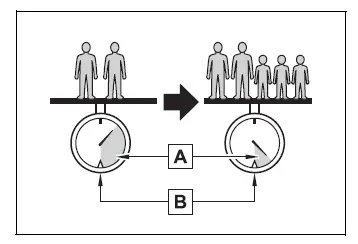
- Cargo capacity available for luggage and other carried items
- Total load capacity, also referred to as the vehicle capacity weight
When two people with a combined weight of A lb. (kg) are traveling in a vehicle with a total load capacity, or vehicle capacity weight, of B lb. (kg), the available cargo and luggage capacity is C lb. (kg), calculated as follows:
B*2 lb. (kg) - A*1 lb. (kg) = C*3 lb. (kg)
*1: A = Combined weight of the occupants
*2: B = Total load capacity of the vehicle
*3: C = Available cargo and luggage capacity
Under these conditions, if three additional passengers with a combined weight of D lb. (kg) enter the vehicle, the remaining cargo and luggage capacity will be reduced to E lb. (kg), as shown below:
C lb. (kg) - D*4 lb. (kg) = E*5 lb. (kg)
*4: D = Combined weight of the additional occupants
*5: E = Remaining available cargo and luggage capacity
As demonstrated in this example, adding occupants reduces the available cargo capacity by an amount equal to their combined weight. If additional passengers cause the combined weight of all occupants, cargo, and luggage to exceed the total load capacity, remove enough cargo or luggage to bring the Toyota RAV4 within the specified limit before driving.
WARNING
■ When loading cargo on the roof luggage carrier (if equipped)
Observe the following precautions when securing cargo to the roof luggage carrier:
- Position the cargo so that its weight is distributed as evenly as possible between the front and rear axles. Avoid concentrating the entire load at one end of the carrier.
- When transporting long or wide cargo, make sure it does not cause the load to exceed the vehicle’s permitted overall length or width.
- Before driving, confirm that the cargo is securely fastened to the roof luggage carrier and cannot shift, loosen, or detach.
- Loading cargo on the roof luggage carrier raises the vehicle’s center of gravity and may change steering and cornering behavior. Avoid high speeds, rapid acceleration, sharp turns, sudden braking, and abrupt steering. Incorrect operation under these conditions may lead to loss of control, vehicle rollover, death, or serious injury.
- During long trips, when traveling on rough roads, or when driving at higher speeds, stop periodically in a safe location and check that the cargo and all fastening points remain secure.
- Do not place more than 176.4 lb. (80 kg) of cargo on the roof luggage carrier.
NOTICE
■ When loading cargo on the roof luggage carrier (if equipped)
Position and secure roof-mounted cargo carefully so that it does not contact, scratch, or otherwise damage the surface of the moon roof or panoramic moon roof, if equipped.
Vehicle load limits Toyota RAV4 XA50
Vehicle load limits for the Toyota RAV4 include the total load capacity, seating capacity, TWR (Trailer Weight Rating), and available cargo capacity. Understanding these limits helps ensure that passengers, luggage, and any trailer load are carried safely without exceeding the vehicle’s permitted ratings.
- Total load capacity (vehicle capacity weight)
Total load capacity is the maximum combined weight of all occupants, cargo, and luggage carried in or on the vehicle. Every passenger and item must be included when determining the actual load placed on the Toyota RAV4.
- Seating capacity
Seating capacity refers to the maximum number of occupants the vehicle is designed to carry. For load calculations, the estimated average weight of each occupant is 150 lb. (68 kg).
- TWR (Trailer Weight Rating)
TWR is the maximum permitted gross trailer weight that the vehicle can tow. Gross trailer weight includes the weight of the trailer itself together with all cargo, equipment, and other items loaded onto or inside it.
- Cargo capacity
Cargo capacity is the amount of weight remaining for luggage and other carried items after the weight of all occupants has been taken into account. As the number or combined weight of passengers increases, the available cargo capacity decreases accordingly.
■ Total load capacity and seating capacity
The applicable total load capacity and seating capacity are also listed on the tire and loading information label. Check this label before carrying a heavy load or traveling with several occupants, and make sure the combined weight remains within the specified limit for the Toyota RAV4.
WARNING
■ Overloading the vehicle
Never overload the vehicle or exceed its specified load ratings. Excessive weight can damage the tires and other vehicle components, reduce steering response, increase stopping distance, and adversely affect overall stability. These conditions may result in loss of control and a serious accident.
Trailer towing Toyota RAV4 fifth generation
Your vehicle is designed primarily to transport passengers, cargo, and luggage.
Towing a trailer changes the way the Toyota RAV4 handles and may adversely affect acceleration, braking, durability, stability, and fuel consumption. The additional weight also increases the demands placed on the engine, transmission, suspension, tires, and braking system.
For your safety and the safety of other road users, never overload the vehicle or trailer. Use towing equipment that is suitable for the intended trailer, make sure every component has been installed correctly, and operate the equipment according to the manufacturer’s instructions. Safe towing also requires careful loading, regular inspections, and driving techniques appropriate for the added weight and length.
Vehicle and trailer stability, as well as overall braking performance, depend on several factors. These include the trailer’s design and stability, brake condition and adjustment, trailer brake operation, tongue weight, cargo distribution, and the condition and installation of the hitch and related towing components, if equipped.
To tow safely with the Toyota RAV4, remain especially cautious and adapt your speed, following distance, steering, and braking to the trailer’s size, weight, handling characteristics, and current road conditions.
Toyota warranties do not cover damage or malfunctions caused by towing a trailer for commercial purposes.
Contact your Toyota dealer for further information about towing requirements, compatible equipment, installation procedures, and whether an additional towing kit or related components are required for your Toyota RAV4.
■ Before towing
Before connecting and towing a trailer, verify that all of the following conditions have been satisfied:
- Make sure the vehicle’s tires are inflated to the specified pressures and are in suitable condition for towing.
- Inflate the trailer tires according to the pressures recommended by the trailer manufacturer.
- Confirm that all trailer lights and reflectors operate correctly and comply with applicable legal requirements.
- Test the trailer lights every time the electrical connector is attached, even if they worked during the previous trip.
- Make sure the trailer ball is positioned at the correct height for the trailer coupler and that the connection is secure.
- Confirm that the trailer remains level after it has been connected to the vehicle.
Do not drive if the trailer is not level. Check for incorrect tongue weight, uneven or excessive loading, worn suspension components, improper hitch height, or another condition that may be affecting the trailer’s position.
- Make sure all cargo inside or on the trailer is properly distributed and securely restrained so that it cannot shift during acceleration, braking, or cornering.
- Confirm that the rearview mirrors comply with all applicable federal, state, provincial, and local requirements. If visibility is insufficient or the installed mirrors do not meet towing regulations, fit appropriate towing mirrors before driving.
■ When towing a trailer
Disable the following systems before towing because their detection, assistance, or braking functions may not operate correctly with a trailer connected:
- LTA (Lane Tracing Assist)
- Dynamic radar cruise control with full-speed range
- PKSB (Parking Support Brake), if equipped
- BSM (Blind Spot Monitor), if equipped
- Intuitive parking assist, if equipped
- RCTA (Rear Cross Traffic Alert) function, if equipped
WARNING
■ Trailer towing precautions
Exercise extreme care whenever towing a trailer. Operate the Toyota RAV4 according to the trailer’s weight, dimensions, handling characteristics, and the prevailing traffic, road, and weather conditions.
Failure to use proper towing procedures may cause a collision resulting in death or serious injury. The vehicle will accelerate, turn, and stop differently when a trailer is attached. Stability and braking performance are influenced by trailer movement, brake adjustment and condition, cargo distribution, tongue weight, and the hitch system.
■ To avoid accident or injury
- Never exceed the specified TWR, unbraked TWR, GCWR, GVWR, or GAWR. Every applicable weight rating must remain within its permitted limit.
- Vehicles equipped with a towing package: If the gross trailer weight exceeds 2000 lb. (907 kg), use a sway control device with sufficient capacity for the trailer and load.
- Keep the tongue weight within the appropriate range. Position heavier cargo as close to the trailer axle as practical, distribute the remaining load evenly, and secure every item to prevent movement.
- Do not exceed 65 mph (104 km/h), the posted towing speed limit, or the maximum speed specified in the trailer owner’s manual, whichever is lowest. Reduce speed well before entering a turn and whenever driving in crosswinds, rain, or on wet, icy, loose, or otherwise slippery surfaces. Abrupt steering or braking with a trailer attached may cause instability, trailer sway, loss of control, or a serious accident.
If vehicle-trailer instability begins at a particular speed, gradually reduce the speed without making abrupt steering or braking inputs. Continue driving below the speed at which the instability occurred, and do not accelerate again until the Toyota RAV4 and trailer are completely stable.
- Avoid jerky steering, abrupt lane changes, and sharp turns. Make all directional changes smoothly and allow additional space for the trailer to follow the vehicle safely.
- Do not apply the brakes suddenly, as abrupt braking may cause the tires to skid, the trailer to swing sideways, or the vehicle and trailer to jackknife. The risk of losing control is particularly high on wet, icy, loose, or otherwise slippery road surfaces.
- Never exceed the permitted trailer hitch assembly weight, gross vehicle weight, gross axle weight, or trailer tongue weight capacity. Each applicable rating must remain within its specified limit throughout the trip.
- Do not use dynamic radar cruise control with full-speed range while towing a trailer, as the system may not respond appropriately to the altered braking distance and handling characteristics.
- Reduce speed and select a lower gear before beginning a steep or extended downhill descent. Avoid sudden downshifts while traveling downhill, as an abrupt change in engine braking may disturb vehicle-trailer stability.
- Vehicle-trailer instability is more likely to develop on long, steep downhill grades.
Before beginning the descent, slow the Toyota RAV4 and select an appropriate lower gear. Do not shift down suddenly while descending. Avoid holding the brake pedal continuously or applying the brakes too frequently, and maintain enough distance from traffic ahead to allow controlled deceleration.
Prolonged or repeated braking can cause the brakes to overheat, significantly reducing braking performance and increasing stopping distance.
- Vehicles equipped with a compact spare tire: Do not tow a trailer while the compact spare tire is installed. The temporary tire is not designed to support the additional load and operating demands associated with trailer towing.
- Vehicles equipped with an emergency tire puncture repair kit: Do not tow a trailer while any tire installed on the vehicle has been temporarily repaired using the emergency puncture repair kit.
■ When towing a trailer
Toyota recommends using a trailer equipped with brakes that comply with all applicable federal, state, provincial, and local regulations. Properly functioning trailer brakes help manage the additional weight and reduce the braking load placed on the Toyota RAV4.
- If the gross trailer weight exceeds the unbraked TWR, trailer brakes are required. Toyota recommends that the trailer braking system be properly rated for the trailer and comply with every applicable federal and state or provincial requirement.
- Never connect a trailer braking system directly to the vehicle’s hydraulic brake system. Modifying or tapping into the hydraulic circuit may reduce braking effectiveness, damage brake components, and create a serious safety hazard.
- Never tow a trailer without a suitable safety chain securely connected to both the trailer and the Toyota RAV4. Install the chain correctly and confirm that it allows sufficient movement for turning without dragging on the road.
If the coupler, hitch ball, or another part of the connection fails, the safety chain helps prevent the trailer from separating completely and wandering into another traffic lane.
Towing related terms Toyota RAV4 2026
■ GCWR (Gross Combination Weight Rating)
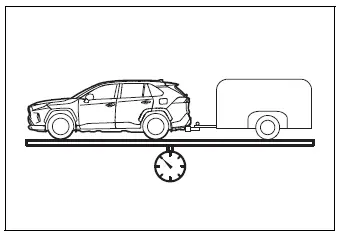
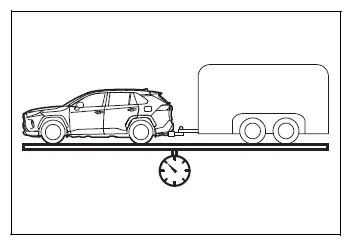
GCWR is the maximum allowable gross combination weight for the Toyota RAV4 and the trailer it is towing. Gross combination weight is calculated by adding the total weight of the vehicle, including the driver, passengers, cargo, luggage, and any optional equipment installed on the vehicle, to the complete weight of the trailer and everything carried inside or on it.
Vehicles without towing package
Vehicles with towing package
■ GVWR (Gross Vehicle Weight Rating)
GVWR is the maximum allowable gross weight of the vehicle itself. The gross vehicle weight includes the Toyota RAV4, all occupants, cargo, luggage, and any optional equipment installed on the vehicle. When towing a trailer, the tongue weight applied to the hitch must also be included in the vehicle’s total weight.
Vehicles without towing package
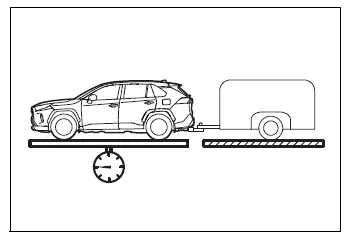
Vehicles with towing package
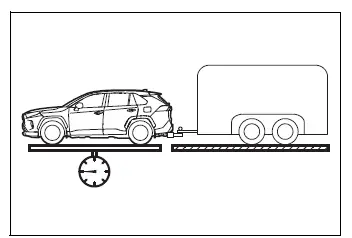
■ GAWR (Gross Axle Weight Rating)
GAWR is the maximum allowable weight that may be supported by an individual axle. The load carried by the front axle and the load carried by the rear axle must each remain within their respective ratings, even when the total vehicle weight is below the GVWR.
Vehicles without towing package
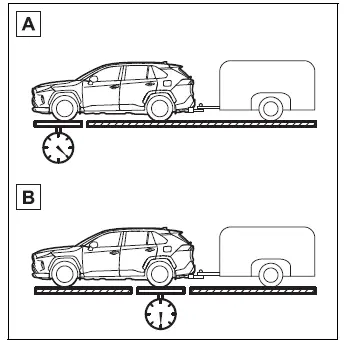
- Front GAWR
- Rear GAWR
Vehicles with towing package
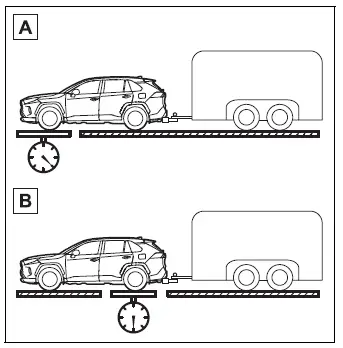
- Front GAWR
- Rear GAWR
■ TWR (Trailer Weight Rating)
TWR is the maximum allowable gross trailer weight. Gross trailer weight includes the weight of the trailer itself together with all cargo, equipment, supplies, and other items loaded into or onto the trailer.
TWR is calculated for a base vehicle carrying one driver and one front passenger, with the towing package installed if available, as well as the required hitch and related hitch components.
Additional passengers, cargo, luggage, accessories, or optional equipment carried by the Toyota RAV4 reduce the amount of trailer weight that can be towed. The actual combination must remain within the applicable GCWR, GVWR, and front and rear GAWR limits.
Vehicles with towing package: If the gross trailer weight exceeds 3000 lb. (1360 kg), Toyota recommends using a trailer equipped with two or more axles to provide more suitable load support and stability.
Vehicles without towing package
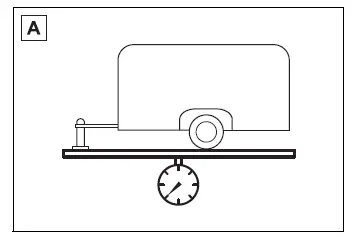
- Trailer equipped with brakes
Vehicles with towing package
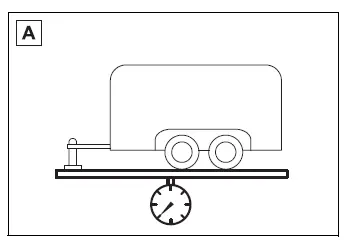
- Trailer equipped with brakes
■ Unbraked TWR (Unbraked Trailer Weight Rating)
Unbraked TWR is the maximum allowable trailer weight when towing a trailer that is not equipped with its own service brake system. This rating is lower because the vehicle’s braking system must slow both the vehicle and trailer.
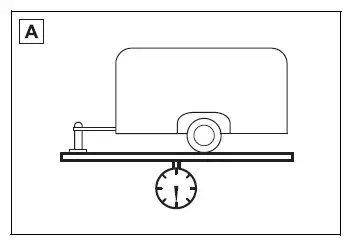
- Trailer without brakes
■ Tongue Weight
Tongue weight is the downward load applied by the trailer coupler to the hitch ball. Correct tongue weight and balanced trailer loading are important for stable handling, predictable steering, and controlled braking while towing.
Vehicles without towing package
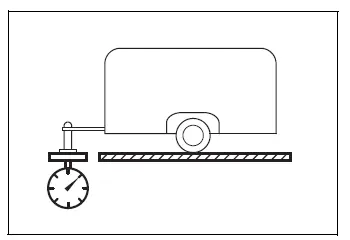
Vehicles with towing package
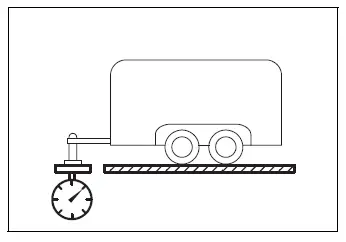
Weight limits
- The gross trailer weight must never exceed the applicable TWR listed below. Include the trailer itself and every item carried in or on it when calculating this weight.
Without towing package
1500 lb. (680 kg)
With towing package
3500 lb. (1590 kg)
The combined weight of the loaded vehicle and loaded trailer must never exceed the applicable GCWR specified below.
Without towing package
Vehicles without Dynamic Torque Vectoring AWD system: 6110 lb.
(2770 kg)
Vehicles with Dynamic Torque Vectoring AWD system: 6205 lb. (2815 kg)
With towing package
8205 lb. (3725 kg)
- The gross vehicle weight must never exceed the GVWR shown on the Certification Regulation Label. Remember that trailer tongue weight is included in the vehicle’s gross weight.
- The load supported by either axle must never exceed the corresponding front or rear GAWR shown on the Certification Regulation Label.
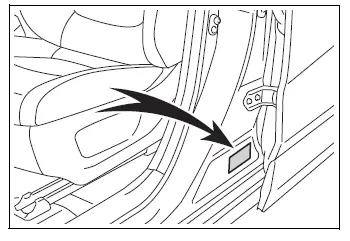
- If the gross trailer weight exceeds the unbraked TWR, the trailer must be equipped with a suitable service brake system that complies with applicable regulations.
- Vehicles with towing package: If the gross trailer weight exceeds 2000 lb. (907 kg), a sway control device with sufficient capacity for the trailer and its load is required.
GCWR, TWR and Unbraked TWR Toyota RAV4 fifth generation
Before towing with the Toyota RAV4, confirm that the gross trailer weight, gross combination weight, gross vehicle weight, gross axle weight, and trailer tongue weight all remain within their specified limits. Each rating must be checked separately because staying within one limit does not automatically mean that all other towing requirements have been satisfied.
■ GCWR*
Without towing package
Vehicles without Dynamic Torque Vectoring AWD system: 6110 lb. (2770 kg)
Vehicles with Dynamic Torque Vectoring AWD system: 6205 lb. (2815 kg)
(2815 kg)
With towing package
8205 lb. (3725 kg)
*: These models comply with the SAE International tow-vehicle trailering requirements specified in SAE J2807.
■ TWR*
Without towing package
1500 lb. (680 kg)
With towing package
3500 lb. (1590 kg)
*: These Toyota RAV4 models comply with the SAE International tow-vehicle trailering requirements specified in SAE J2807.
■ Unbraked TWR*
1000 lb. (450 kg)
*: These models comply with the SAE International tow-vehicle trailering requirements specified in SAE J2807.
Trailer Tongue Weight
- The recommended tongue weight varies according to the trailer design, cargo arrangement, and type of towing operation.
- To achieve the recommended values shown below, load and balance the trailer carefully by following the applicable instructions.
- Tongue Weight
The gross trailer weight should be distributed so that the tongue weight equals approximately 9% to 11% of the total loaded trailer weight. Proper tongue weight helps the trailer remain stable and follow the Toyota RAV4 more predictably during acceleration, braking, and cornering.
(Tongue weight / Gross trailer weight x 100 = 9% to 11%)
Vehicles without towing package
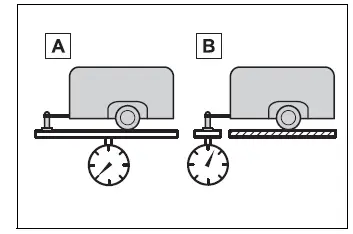
- Gross trailer weight, including the trailer and all cargo carried in or on it
- Tongue weight applied to the trailer hitch ball
Vehicles with towing package
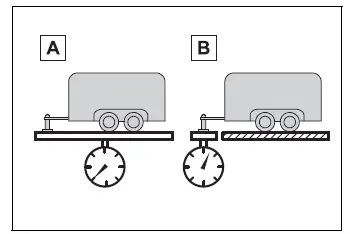
- Gross trailer weight, including the complete loaded trailer
- Tongue weight supported by the hitch ball
The gross trailer weight, gross axle weight, and tongue weight can be measured using suitable platform scales commonly available at highway weighing stations, building supply companies, trucking facilities, junk yards, and similar locations. Weigh the vehicle and trailer in their actual loaded condition to obtain accurate values before beginning a towing trip.
Hitch
Trailer hitch assemblies are manufactured with different maximum weight capacities. The hitch, hitch ball, mounting hardware, and related components must all be suitable for the intended trailer and must not be loaded beyond their individual ratings.
Toyota recommends using a Toyota hitch and bracket designed for your vehicle. Contact your Toyota dealer for information about compatible towing components and installation requirements for the Toyota RAV4.
- If you plan to install a trailer hitch, consult your Toyota dealer before installation.
- Use only a hitch with a weight rating that meets or exceeds the gross trailer weight requirements applicable to your vehicle.
- Follow all installation, inspection, tightening, and maintenance instructions supplied by the hitch manufacturer.
- Apply a light coating of grease to the hitch ball to reduce friction and allow the trailer coupler to move smoothly during turns.
- Remove the hitch ball whenever the vehicle is not being used to tow a trailer. Remove the trailer hitch as well if it is no longer required.
After removing the hitch, seal all exposed mounting holes in the vehicle body to prevent water, dirt, road salt, dust, or other substances from entering and causing corrosion or damage.
WARNING
■ Hitch
Trailer hitch assemblies have individual maximum weight capacities established by their manufacturers. These ratings may differ from the maximum towing capacity specified for the vehicle.
Even if the Toyota RAV4 is capable of towing a heavier trailer, the driver must determine the maximum permitted rating of the particular hitch assembly and never exceed it. The lowest applicable rating among the vehicle, hitch, hitch ball, mounting hardware, and trailer must always be treated as the maximum allowable limit. Exceeding the hitch manufacturer’s rating may cause the towing connection to fail, resulting in loss of the trailer, an accident, death, or serious injury.
NOTICE
■ When installing a trailer hitch
Install the trailer hitch only in the mounting position recommended by your Toyota dealer and follow the specified installation procedure.
Do not install or attach the trailer hitch directly to the bumper. The bumper is not designed to support trailer loads, and doing so may damage the bumper, vehicle body, or surrounding components.
Selecting trailer ball (vehicles with towing package) Toyota RAV4 (XA50)
Select a trailer ball that is correctly sized and rated for the intended towing application. Using compatible towing hardware helps maintain a secure connection between the Toyota RAV4 and the trailer while reducing the risk of component damage or separation.
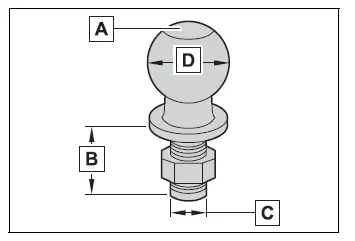
- Trailer ball load rating
The trailer ball rating must match or exceed the gross trailer weight rating of the fully loaded trailer. Never use a ball with a lower capacity than the trailer requires. - Shank length
The threaded shank must extend beyond the bottom of the lock washer and retaining nut by at least two complete threads after installation and tightening. - Shank diameter
The shank diameter must correspond exactly to the diameter of the opening in the ball mount. An incorrect fit may prevent secure installation or allow unwanted movement. - Ball diameter
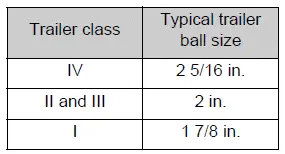
The trailer ball diameter must match the size required by the trailer coupler.Most trailer couplers are stamped or marked with the required ball diameter. Check this marking before connecting the trailer to the Toyota RAV4.
Positions for towing hitch receiver and hitch ball
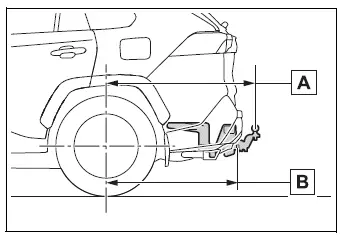
- Weight-carrying trailer ball position: 43.3 in. (1100 mm)
- Hitch receiver pin hole position: 38.1 in. (969 mm)
■ Matching trailer ball height to trailer coupler height
Regardless of the tow hitch class being used, the trailer ball must be positioned at the correct height for the trailer coupler. When the trailer is connected, it should remain as level as possible to support stable handling, appropriate load distribution, and a secure coupling.
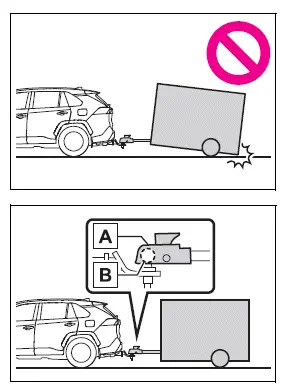
- Trailer coupler
- Trailer ball
Connecting trailer lights
Consult your Toyota dealer when installing or connecting trailer lights. Incorrect wiring or unsuitable electrical components may damage the Toyota RAV4 lighting circuits or cause the vehicle and trailer lights to operate improperly.
Make sure the trailer lighting installation complies with all applicable state, provincial, and local laws. Confirm that the brake lights, turn signals, tail lights, and any required marker lights function correctly before every towing trip.
NOTICE
■ Do not directly splice trailer lights
Do not connect trailer lighting by cutting into or directly splicing the vehicle’s original wiring.
Directly splicing trailer light wires may overload or damage the Toyota RAV4 electrical system, cause lighting malfunctions, or affect other electronically controlled components.
Trailer towing tips
The Toyota RAV4 will accelerate, steer, turn, and stop differently when a trailer is attached. To reduce the risk of an accident, death, or serious injury, adjust your driving technique and observe the following towing precautions:
- Trailer towing speed limits vary by state, province, and local jurisdiction.
Always obey the posted towing speed limit and any lower limit that applies to the trailer or road conditions.
- Toyota recommends limiting the vehicle-and-trailer combination to 65 mph (104 km/h) on a level, straight, and dry road. Do not exceed this speed, the posted towing limit, or the maximum speed specified by the trailer manufacturer, whichever is lowest.
The possibility of trailer sway and vehicle-trailer instability increases as speed rises. Driving too fast may make the combination difficult to control and could lead to trailer separation, rollover, or a collision.
- Before beginning a trip, inspect the trailer lights, tires, hitch, safety chains, electrical connector, coupler, and all vehicle-to-trailer connections.
Stop after driving a short distance and check the connections again, as towing hardware and cargo restraints may settle or loosen after the trailer begins moving.
- Practice accelerating, turning, braking, and reversing with the trailer attached in a safe area away from traffic. Continue practicing until you understand how the added length and weight affect the response of the Toyota RAV4.
- Reversing with a trailer requires additional care and practice. Hold the bottom of the steering wheel and move your hand to the left to direct the trailer toward the left, or move your hand to the right to direct it toward the right. This movement is generally opposite to the steering technique used when reversing without a trailer. Use small steering inputs, avoid sharp or prolonged turns, and ask another person to guide you whenever visibility is limited.
- Because towing increases the distance required to slow or stop, maintain a substantially greater following distance from the vehicle ahead. Begin braking earlier than usual, apply the brake pedal smoothly, and leave enough space to stop the loaded Toyota RAV4 and trailer without abrupt braking.
For every 10 mph (16 km/h) of vehicle speed, maintain at least one complete Toyota RAV4-and-trailer length between your vehicle and the vehicle ahead. Increase this distance further when visibility, traffic, road, or weather conditions are unfavorable.
- Avoid sudden braking, as the vehicle or trailer may skid, causing the trailer to jackknife and making the combination difficult to control. This risk is especially high on wet, icy, loose, or otherwise slippery road surfaces.
- Avoid abrupt starts and rapid acceleration. Apply the accelerator gradually so that the trailer load remains stable and the tires maintain proper traction.
- Avoid sudden steering movements and sharp turns. Reduce speed before entering a turn, steer smoothly, and allow the trailer enough space to follow without becoming unstable.
- When turning, remember that the trailer wheels travel closer to the inside of the curve than the Toyota RAV4 wheels. Use a wider turning radius than normal to prevent the trailer from striking curbs, signs, parked vehicles, or other roadside objects.
- Reduce speed before turning and whenever driving in crosswinds, rain, or on wet, icy, loose, or slippery surfaces. Smooth steering and controlled acceleration help maintain vehicle-trailer stability.
Higher vehicle speeds can make the trailer increasingly unstable and may cause trailer sway. Always remain below the applicable towing speed limit and reduce speed immediately if the trailer begins to move from side to side.
- Use particular care when passing another vehicle. Overtaking with a trailer requires substantially more time and distance than normal driving. After passing, remember the full length of the Toyota RAV4 and trailer, and make sure there is ample clearance before returning to the original lane.
- To maintain effective engine braking and charging system performance while using engine braking, do not leave the transmission in D. When S mode is selected, set the transmission shift range to position 6 or lower, choosing a range appropriate for the road gradient and vehicle speed.
- Vehicle-trailer instability is more likely when descending a long or steep downhill grade.
Before beginning the descent, reduce speed and select a lower shift range. Do not make abrupt downshifts while traveling down a steep or extended grade, as sudden engine braking may disturb the balance of the vehicle-trailer combination.
- Do not hold the brake pedal down continuously or apply the brakes too frequently. Prolonged braking may cause the brakes to overheat, reduce braking effectiveness, and increase the distance required to stop the loaded vehicle and trailer.
- Because of the additional trailer load, the Toyota RAV4 engine may overheat on hot days, particularly when the outside temperature exceeds 85°F (30°C) and the vehicle is climbing a long or steep grade. If the engine coolant temperature gauge indicates overheating, immediately turn off the air conditioning if it is operating, safely move the vehicle off the road, and stop in a suitable location.
- Whenever parking with a trailer attached, place wheel blocks under the wheels of both the vehicle and trailer. Apply the parking brake firmly and shift the transmission to P. Avoid parking on a slope whenever possible. If parking on an incline cannot be avoided, complete the following procedure carefully:
- Press the brake pedal firmly and keep it depressed so that the Toyota RAV4 and trailer remain stationary.
- Have another person place wheel blocks securely under the appropriate wheels of both the vehicle and trailer.
- After the wheel blocks are correctly positioned, release the brake pedal slowly until the blocks support the weight of the vehicle-trailer combination.
- Apply the parking brake firmly and confirm that the vehicle remains securely held in position.
- Shift the transmission to P and turn off the engine.
- When restarting and moving away after the vehicle and trailer have been parked on a slope, follow the procedure below:
- With the transmission in P, start the engine while keeping the brake pedal firmly depressed.
- Shift into a forward driving position. If the vehicle must move backward, shift the transmission to R.
- If the parking brake is operating in manual mode, release the parking brake while continuing to hold the brake pedal.
- Gradually release the brake pedal and slowly move the vehicle forward or backward away from the wheel blocks. Once the vehicle and trailer are clear of the blocks, stop and press the brake pedal firmly.
- Have another person retrieve all wheel blocks and store them securely before continuing the journey.
■ Break-in schedule
If your Toyota RAV4 is new or has been fitted with new powertrain components, such as an engine, transmission, differential, or wheel bearing, Toyota recommends driving the vehicle for more than 500 miles (800 km) before towing a trailer. This initial break-in period allows the newly installed components to settle into normal operation without the additional stress created by trailer weight.
After the vehicle has traveled more than 500 miles (800 km), trailer towing may begin. However, during the next 500 miles (800 km) of driving with a trailer attached, keep the vehicle speed below 45 mph (72 km/h) and avoid full-throttle acceleration. Smooth acceleration and moderate speeds help reduce unnecessary strain on the Toyota RAV4 powertrain during this important break-in period.
■ Maintenance
- When a trailer is regularly towed, the Toyota RAV4 will require more frequent maintenance because the engine, transmission, brakes, suspension, and other components are subjected to additional load.
Refer to the “Scheduled Maintenance Guide” or “Owner’s Manual Supplement” for the maintenance requirements that apply when the vehicle is used for trailer towing.
- After approximately 600 miles (1000 km) of trailer towing, inspect and retighten the mounting bolts for the trailer ball and bracket. Continued towing can allow newly installed hardware to settle, so correct bolt tightness should be confirmed.
■ If trailer sway occurs
Crosswinds, passing vehicles, uneven pavement, incorrect loading, and other conditions can affect the handling of the vehicle-trailer combination and cause the trailer to sway from side to side. If instability develops, remain calm and avoid sudden control inputs.
- If trailer sway begins:
- Hold the steering wheel firmly and keep the Toyota RAV4 directed straight ahead.
Do not attempt to correct trailer sway by repeatedly or sharply turning the steering wheel, as abrupt steering may increase the instability.
- Immediately begin releasing the accelerator pedal, but do so slowly and gradually to reduce vehicle speed in a controlled manner.
Do not accelerate, and do not apply the vehicle brakes suddenly while the trailer is swaying.
- Hold the steering wheel firmly and keep the Toyota RAV4 directed straight ahead.
If you avoid extreme steering corrections and sudden braking, the vehicle and trailer should gradually stabilize. When enabled and its operating conditions are met, Trailer Sway Control may also assist in restoring stability to the Toyota RAV4 and trailer.
- After the trailer sway has completely stopped:
- Move off the road and stop in a safe location. Have all occupants leave the vehicle and remain in a secure area away from traffic while the vehicle and trailer are inspected.
- Inspect the tires on both the vehicle and trailer for damage, incorrect inflation, or other visible problems that could have contributed to the instability.
- Inspect the cargo carried in the trailer.
Confirm that the load has not shifted, become loose, or moved unevenly to one side.
Check that the tongue weight remains within the appropriate range whenever it is possible to do so safely.
- Check the cargo and passenger load inside the vehicle.
After all occupants return to their seats, confirm that the Toyota RAV4 is not overloaded and that all carried items remain securely positioned.
If no tire, loading, hitch, or mechanical problem can be identified, the speed at which the trailer began swaying may be too high for that particular vehicle-and-trailer combination under the existing conditions.
Continue the journey at a lower speed to reduce the likelihood of renewed instability. Trailer sway generally becomes more severe as vehicle speed increases, so remain below the speed at which the previous movement occurred and adjust your speed further for wind, traffic, and road conditions.
Dinghy towing Toyota RAV4
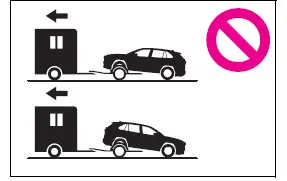
The Toyota RAV4 is not designed for dinghy towing behind a motor home with all four wheels in contact with the ground. Using this towing method may cause severe damage to the vehicle’s drivetrain and related components.
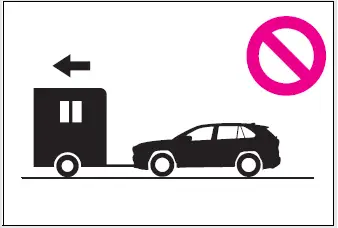
NOTICE
■ To avoid serious damage to your vehicle
Never tow the Toyota RAV4 with all four wheels on the ground. Use an approved transportation or towing method that keeps the required wheels completely off the road.
■ To prevent causing serious damage to the transmission and AWD system (AWD models)
2WD models: Never tow the vehicle from the rear while allowing the front wheels to remain on the ground. Because the front wheels are connected to the transmission, this towing method may cause serious transmission damage.
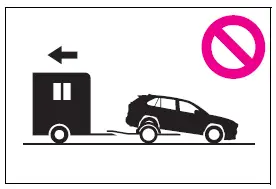
AWD models: Never tow the vehicle with any of its wheels remaining on the ground. Doing so may severely damage the transmission, AWD system, and connected drivetrain components.