
Toyota RAV4: Driving - Operating the lights and wipers
Headlight switch Toyota RAV4 (XA50)
The headlights can be controlled manually or allowed to operate automatically according to the surrounding light conditions.
Turning on the headlights
Rotating the  switch changes the exterior lighting operation as described below:
U.S.A. (Type A)
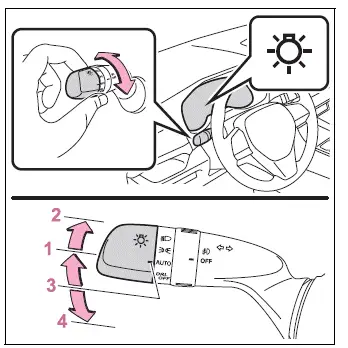
 The side marker, parking, tail, license plate, instrument panel, and daytime running lights turn on.
 The headlights and all of the lights listed above turn on, except for the daytime running lights.
 The headlights, daytime running lights, and the other exterior lights listed above turn on or off automatically according to ambient lighting conditions.
 Off
Off
U.S.A. (Type B)
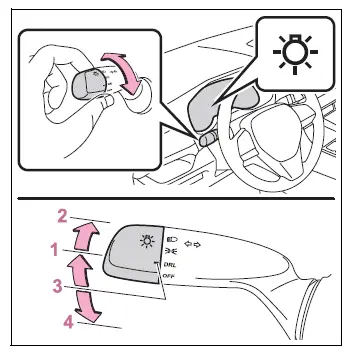
 The side marker, parking, tail, license plate, instrument panel, and daytime running lights turn on.
 The headlights and all of the lights listed above turn on, except for the daytime running lights.
 The daytime running lights turn on.
 Off
Off
Canada
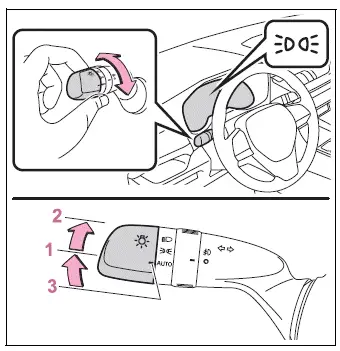
 The side marker, parking, tail, license plate, instrument panel, and daytime running lights turn on.
 The headlights and all of the lights listed above turn on, except for the daytime running lights.
 The headlights, daytime running lights, and all of the other lights listed above turn on or off automatically according to the surrounding brightness.
■ AUTO mode can be used when
AUTO mode is available while the engine switch is in ON.
■ Daytime running light system
- Vehicles equipped with multi-LED headlights or LED projector headlights with bulb-type front turn signal lights: The daytime running lights use the same lamps as the low-beam headlights but illuminate at a lower brightness than the low beams.
- Vehicles equipped with LED projector headlights and LED-type front turn signal lights: The daytime running lights use the same lamps as the parking lights but illuminate more brightly than the parking lights.
- To improve the visibility of the Toyota RAV4 to other road users during daytime driving, the daytime running lights illuminate automatically when all of the following conditions are satisfied.
The daytime running lights are intended for daytime visibility and are not designed to provide sufficient illumination for nighttime driving.
- The engine is running.
- The parking brake is released.
- For the U.S.A.: The headlight switch is in the
 ,
,  , or
, or  * position.
 - For Canada: The headlight switch is in the
 or *
or *  position.
*: When the surrounding area is bright.
After the daytime running lights have illuminated, they remain on even if the parking brake is applied again.
- For the U.S.A.: The daytime running lights can be switched off by operating the headlight switch.
- Compared with continuous headlight operation, the daytime running light system uses less electrical power and is designed for greater service durability, which may also help reduce unnecessary fuel consumption.
■ Headlight control sensor (if equipped)
The headlight control sensor may not operate correctly if an object is placed over it or if a sticker, accessory, or other material that blocks the sensor is attached to the windshield.
Blocking the sensor prevents it from accurately detecting ambient light levels and may interfere with automatic headlight operation.
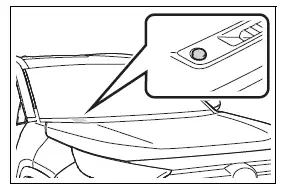
■ Automatic light off system
- When the headlights are on: The lights switch off approximately 30 seconds after the engine switch is moved to ACC or OFF and a door is opened and then closed. The lights turn off immediately if
 on the key is pressed after all doors have been closed.
 - When only the tail lights are on: The tail lights turn off automatically when the engine switch is moved to ACC or OFF and the driver's door is opened.
To illuminate the lights again, turn the engine switch to ON, or move the light switch once to the  ,
,  , or
, or  position, and then return it to the
  or
or  position.
■ Light reminder buzzer
A reminder buzzer sounds if the engine switch is turned to OFF and the driver's door is opened while the exterior lights remain on.
■ Windshield wiper linked headlight illumination (if equipped)
When the Toyota RAV4 is driven during daylight with the headlight switch in the  position, operating the windshield wipers causes the headlights to illuminate automatically after several seconds. This makes the vehicle easier for other road users to see in reduced-visibility conditions.
■ Battery-saving function
To help prevent the vehicle battery from discharging, the battery-saving function automatically turns off all lights after approximately 20 minutes if the headlights and/or tail lights remain illuminated after the engine switch has been turned to OFF.
Performing any of the following operations temporarily cancels the battery-saving function and then activates it again.
After the function has been reactivated, all lights will switch off automatically approximately 20 minutes later:
- The headlight switch is operated.
- A door is opened or closed.
■ If "Headlight System Malfunction Visit Your Dealer" is displayed on the multi-information display
This warning may indicate a malfunction in the headlight control system.
Have the Toyota RAV4 inspected by your Toyota dealer.
■ Customization
Certain lighting settings, including the sensitivity of the light sensor, can be changed.
NOTICE
■ To prevent battery discharge
Do not leave the headlights or other exterior lights on longer than necessary while the engine is not running.
Turning on the high beam headlights
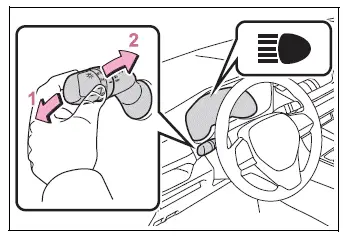
- With the headlights illuminated, push the lever away from you to switch on the high-beam headlights.
To turn the high beams off, pull the lever back toward you until it returns to the center position.
- Pull the lever toward you and release it to flash the high-beam headlights once.
The high beams can be flashed whether the headlights are switched on or off.
AHB (Automatic High Beam) Toyota RAV4
The Automatic High Beam system uses the forward-facing in-vehicle camera to evaluate surrounding brightness, including streetlights and the lights of vehicles ahead. Based on the detected conditions, the system automatically switches the high beams on or off when appropriate.
WARNING
■ Limitations of the Automatic High Beam
Do not rely excessively on the Automatic High Beam system. Always drive attentively, monitor the road and surrounding traffic, and switch between the high and low beams manually whenever conditions require it.
■ To prevent incorrect operation of the Automatic High Beam system
Do not overload the Toyota RAV4, as an improper vehicle attitude may interfere with correct system operation.
Activating the Automatic High Beam system
1. Press the Automatic High Beam switch to enable the system.
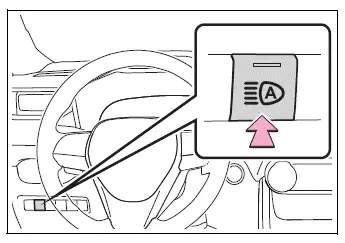
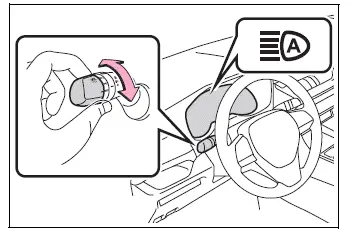
2. Turn the headlight switch to the  or
or  position.
The Automatic High Beam indicator will illuminate when the system is active and ready to control the high beams.
■ High beams automatic turning on or off conditions
- When all of the following conditions are satisfied, the high beams will turn on automatically after approximately 1 second:
- Vehicle speed is approximately 21 mph (34 km/h) or higher.
- The area ahead of the vehicle is dark.
- No vehicles ahead are detected with their headlights or tail lights illuminated.
- There are few streetlights along the road ahead.
- If any of the following conditions occur, the system will automatically switch the high beams off:
- Vehicle speed decreases below approximately 17 mph (27 km/h).
- The area ahead is no longer sufficiently dark.
- A vehicle ahead is detected with its headlights or tail lights illuminated.
- Numerous streetlights are present along the road ahead.
■ Front camera detection information
- The system may not switch the high beams off automatically in the following situations:
- An oncoming vehicle suddenly appears from around a curve.
- Another vehicle moves into the lane directly ahead of the Toyota RAV4.
- Vehicles ahead are temporarily hidden by repeated curves, road dividers, roadside trees, or similar obstructions.
- A vehicle ahead appears in a distant lane on a wide road.
- A vehicle ahead is traveling without its lights illuminated.
- The high beams may switch off if the camera detects a vehicle ahead using fog lights without its headlights.
- Light from houses, streetlights, traffic signals, illuminated billboards, or road signs may cause the system to change to low beams or keep the low beams illuminated.
- The following factors may influence how quickly the system switches between the high and low beams:
- The brightness of the headlights, fog lights, and tail lights of vehicles ahead.
- The movement, position, and direction of vehicles ahead.
- A vehicle ahead having functional lights on only one side.
- A vehicle ahead being a motorcycle or another two-wheeled vehicle.
- Road characteristics, including gradients, curves, and the condition of the road surface.
- The number of passengers and the amount of luggage carried in the vehicle.
- The high beams may occasionally turn on or off at a time the driver does not expect.
- Bicycles and similar objects may not be recognized reliably by the front camera.
- Under the conditions listed below, the system may be unable to determine surrounding brightness accurately. The low beams may remain on, or the high beams may create discomfort or reduced visibility for pedestrians, drivers ahead, or other road users. In these situations, switch between the high and low beams manually.
- During adverse weather, including rain, snow, fog, or sandstorms.
- The windshield is obscured by fog, mist, ice, snow, dirt, or other material.
- The windshield is cracked or otherwise damaged.
- The front camera is deformed, obstructed, or dirty.
- The temperature of the front camera becomes extremely high.
- The surrounding brightness is similar to the brightness of headlights, tail lights, or fog lights.
- The headlights or tail lights of a vehicle ahead are switched off, dirty, discolored, damaged, or aimed incorrectly.
- Water, snow, dust, or other material is thrown toward the vehicle by a preceding vehicle.
- The vehicle is traveling through an area where brightness and darkness change repeatedly.
- The vehicle frequently travels uphill or downhill, or over rough, uneven, bumpy, gravel, or stone-paved roads.
- The vehicle repeatedly travels through curves or along a winding road.
- A highly reflective object, such as a road sign or mirror, is positioned ahead.
- The rear surface of a vehicle ahead is highly reflective, such as the container of a truck.
- The vehicle's headlights are dirty, damaged, or aimed incorrectly.
- The vehicle is leaning or tilted because of a flat tire, a trailer being towed, or another similar condition.
- The high and low beams are switching repeatedly in an unusual or inconsistent manner.
- The driver believes the high beams may be disturbing, dazzling, or inconveniencing nearby drivers or pedestrians.
■ If "Headlight System Malfunction Visit Your Dealer" is displayed on the multi-information display
This message may indicate a malfunction in the headlight control system. Have the Toyota RAV4 inspected by your Toyota dealer as soon as possible.
■ Temporarily lowering sensor sensitivity
The sensitivity of the Automatic High Beam sensor can be temporarily reduced by completing the following procedure in the specified order.
1. Turn the engine switch to OFF while all of the following conditions are satisfied.
- The headlight switch is in the
 or
or  position.
 - The headlight switch lever is in the high-beam position.
- The Automatic High Beam switch is turned on.
2. Turn the engine switch of the Toyota RAV4 to ON.
3. Within 60 seconds after completing step 2, quickly pull the headlight switch lever back to its original position and then push it forward to the high-beam position. Repeat this sequence 10 times, and leave the lever in its original position after the final operation.
4. When the sensor sensitivity has been changed successfully, the Automatic High Beam indicator will flash on and off 3 times.
After the sensitivity has been reduced, the Automatic High Beam headlights may illuminate even while the Toyota RAV4 is stopped.
Turning the high beams on/off manually
■ Switching to the high beams
Push the headlight switch lever away from you to turn on the high beams manually.
The Automatic High Beam indicator will turn off, and the high-beam headlight indicator will illuminate to confirm manual high-beam operation.
Return the headlight switch lever to its original position to reactivate the Automatic High Beam system on the Toyota RAV4.
■ Switching to the low beams
Press the Automatic High Beam switch to change from automatic high-beam operation to the low beams.
The Automatic High Beam indicator will turn off, confirming that the system has been deactivated.
Press the switch again when you want to reactivate the Automatic High Beam system.
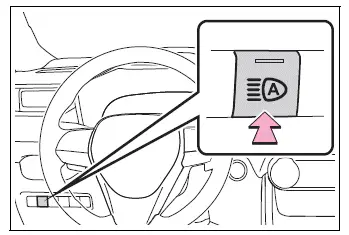
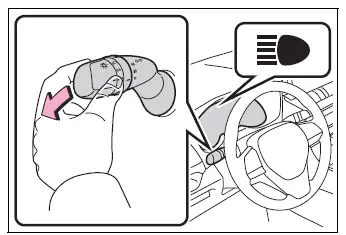
■ Temporarily switching to the low beams
Pull the headlight switch lever toward you, and then return it to its original position.
The high beams remain illuminated while the lever is held toward you. After the lever is released and returns to its original position, the low beams stay on temporarily. Once this period has elapsed, Automatic High Beam operation will resume automatically.
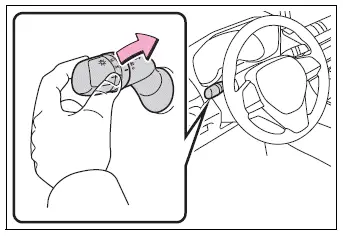
■ Temporarily switching to the low beams
Switch the Toyota RAV4 to the low beams whenever the high beams could dazzle, distract, or otherwise inconvenience nearby drivers or pedestrians. Always use the lighting mode that is appropriate for the surrounding traffic and road conditions.
Fog light switch Toyota RAV4 (XA50)
The fog lights improve forward visibility in challenging driving conditions, including rain, fog, and other situations where normal visibility is reduced.
Operating procedure
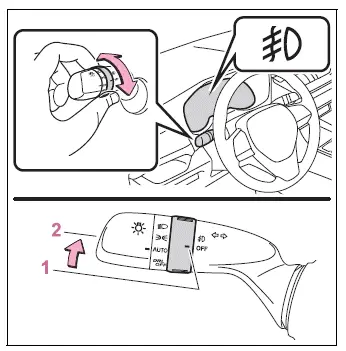
 *1 or
*1 or  *2 Turns the fog lights off.
 Turns the fog lights on.
*1: For the U.S.A.
*2: For Canada
■ Fog lights can be used when
The fog lights can be operated while the headlights are illuminated in low-beam mode.
Windshield wipers and washer Toyota RAV4 compact crossover
Operating the wiper lever allows the driver to select automatic or manual wiping, depending on the equipment installed, and to activate the windshield washer when cleaning is required.
NOTICE
■ When the windshield is dry
Do not operate the windshield wipers on a dry windshield, as the wiper blades may scratch or otherwise damage the glass.
Operating the wiper lever
Moving the  lever operates the windshield wipers or washer as described below:
Intermittent windshield wipers
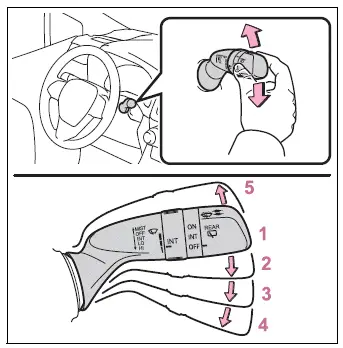
 *1 or
*1 or  *2 Off
 *1 or
*1 or  *2 Intermittent operation
 *1 or
*1 or  *2 Low-speed operation
 *1 or
*1 or  *2 High-speed operation
 *1 or
*1 or  *2 Temporary operation
*1: For the U.S.A.
*2: For Canada
If equipped, the interval between wiping cycles can be adjusted while intermittent operation is selected, allowing the driver to match the wiping frequency to the amount of moisture on the windshield.
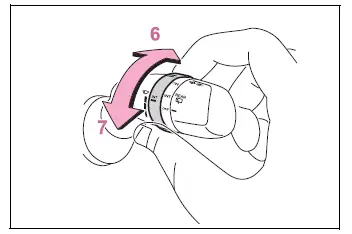
- Increases the intermittent windshield wiper frequency.
- Decreases the intermittent windshield wiper frequency.
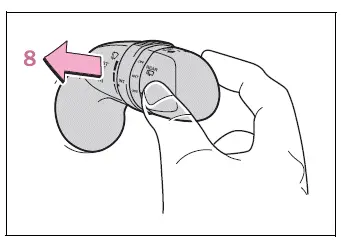
 Washer/wiper dual operation
Pulling the lever toward you activates the windshield washer and operates the wipers.
After washer fluid is sprayed onto the windshield, the wipers automatically operate several times to help clear the glass.
Rain-sensing windshield wipers
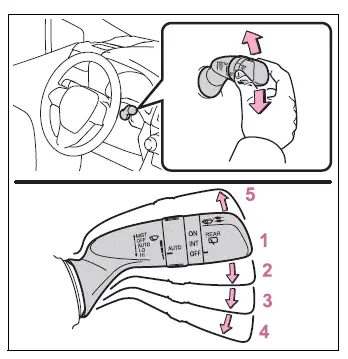
 *1 or
*1 or  *2 Off
 Rain-sensing operation
 *1 or
*1 or  *2 Low-speed operation
 *1 or
*1 or  *2 High-speed operation
 *1 or
*1 or  *2 Temporary operation
*1: For the U.S.A.
*2: For Canada
When "AUTO" is selected, the windshield wipers operate automatically whenever the sensor detects rain. The system adjusts the timing and frequency of each wiping cycle according to the amount of rainfall and the speed of the Toyota RAV4.
The sensitivity of the raindrop sensor can be adjusted while "AUTO" operation is selected.
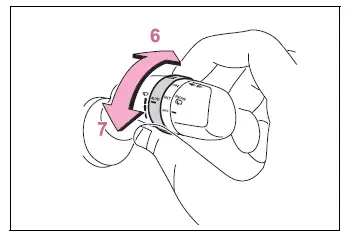
- Increases the sensor sensitivity.
- Decreases the sensor sensitivity.
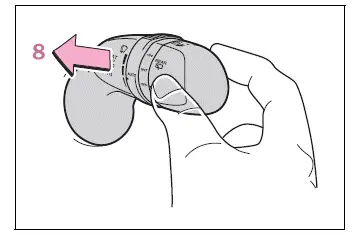
- Washer/wiper dual operation
Pulling the lever toward you activates both the windshield washer and the wipers.
Once washer fluid has been sprayed, the wipers automatically sweep the windshield several times to remove the fluid and loosened dirt.
■ The windshield wipers and washer can be operated when
The windshield wipers and washer can be used while the engine switch is in ON.
■ Effects of vehicle speed on wiper operation
Vehicles with intermittent windshield wipers
When low-speed windshield wiper operation is selected, the wipers change from continuous low-speed operation to intermittent operation while the vehicle is stationary. However, this change will not occur when the intermittent interval is adjusted to its highest frequency.
Vehicles with rain-sensing windshield wipers
When low-speed windshield wiper operation is selected, the wipers change from continuous low-speed operation to intermittent operation while the vehicle is stationary. However, the operating mode will not change when the sensor sensitivity is set to its highest level.
■ Raindrop sensor (vehicles with rain-sensing windshield wipers)
- The raindrop sensor detects and evaluates the amount of moisture falling on the windshield so the system can determine an appropriate wiping frequency.
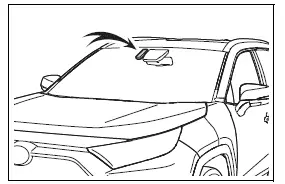
- If the wiper switch is moved to the "AUTO" position while the engine switch is in ON, the wipers operate once to confirm that automatic mode has been activated.
- If the sensor sensitivity is adjusted to a higher setting, the wipers may operate once to confirm that the sensitivity level has changed.
- If the raindrop sensor temperature reaches 185°F (85°C) or higher, or falls to 5°F (-15°C) or lower, automatic operation may not function. Under these conditions, operate the wipers using any mode other than "AUTO".
■ If no windshield washer fluid sprays
If washer fluid is present in the windshield washer reservoir but no fluid is sprayed, check whether the washer nozzles are obstructed.
WARNING
■ Caution regarding the use of windshield wipers in "AUTO" mode (vehicles with rain-sensing windshield wipers)
The windshield wipers may begin operating unexpectedly if the sensor is touched or if vibration is applied to the windshield while "AUTO" mode is selected.
Keep your hands, fingers, clothing, and other objects away from the wipers to prevent them from becoming caught during unexpected operation.
■ Caution regarding the use of washer fluid
In cold weather, do not use the washer until the windshield has warmed sufficiently. Washer fluid may freeze on the glass and severely reduce visibility, potentially causing an accident that could result in death or serious injury.
NOTICE
■ When the washer fluid tank is empty
Do not operate the washer switch continuously when the reservoir is empty, as the washer fluid pump may overheat and become damaged.
■ When a nozzle becomes blocked
If a washer nozzle becomes blocked, contact your Toyota dealer for assistance.
Do not attempt to clear the nozzle with a pin, needle, or another sharp object, as doing so may damage the nozzle or alter its spray direction.
■ To prevent battery discharge
Do not leave the windshield wipers operating longer than necessary while the engine is not running.
Rear window wiper and washer Toyota RAV4 (XA50)
The rear window wiper and washer are controlled with the wiper lever, allowing the rear glass to be cleared when visibility is reduced by rain, road spray, or dirt.
NOTICE
■ When the rear window is dry
Do not operate the rear wiper on a dry rear window, as this may scratch or otherwise damage the glass.
Operating the wiper lever
Turning the  switch operates the rear window wiper as described below:
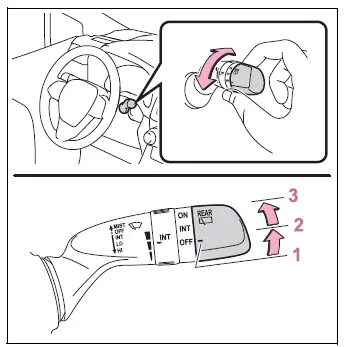
 *1 or
*1 or  *2 Off
 *1 or
*1 or  *2 Intermittent operation
 *1 or
*1 or  *2 Normal operation
*1: For the U.S.A.
*2: For Canada
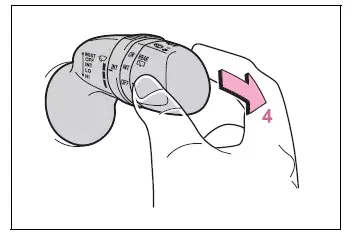
 Washer/wiper dual operation
Pushing the lever activates both the rear window washer and the wiper.
After washer fluid is sprayed onto the rear window, the wiper automatically operates several times to help clear the glass.
■ The rear window wiper and washer can be operated when
The rear window wiper and washer can be used while the engine switch is in ON.
■ If no washer fluid sprays
If washer fluid is present in the reservoir but no fluid is sprayed, check whether the rear washer nozzle is blocked.
■ Back door opening linked rear window wiper stop function
If the back door is opened while the Toyota RAV4 is stopped and the rear window wiper is operating, wiper movement will stop automatically. This helps prevent water from being sprayed toward anyone standing near the rear of the vehicle. Rear wiper operation will resume after the back door is closed.*
*: This setting must be customized by your Toyota dealer.
■ Reverse-linked rear window wiper function
When the shift lever is moved to R while the front windshield wipers are operating, the rear window wiper will operate once to help improve rearward visibility.
■ Customization
The operating setting for the reverse-linked rear window wiper function can be changed.
NOTICE
■ When the washer fluid tank is empty
Do not operate the washer switch continuously when the reservoir is empty, as the washer fluid pump may overheat and become damaged.
■ When a nozzle becomes blocked
If the rear washer nozzle becomes blocked, contact your Toyota dealer for assistance.
Do not attempt to clear the nozzle with a pin, needle, or another sharp object, as this may damage the nozzle or alter the direction of the washer spray.
■ To prevent battery discharge
Do not leave the rear window wiper operating longer than necessary while the Toyota RAV4 engine is not running.