
Toyota RAV4: For safety and security - For safe use
Before driving Toyota RAV4 2026
Observe the following precautions before starting the vehicle to support safe and controlled driving.
Installing floor mats
Use only floor mats designed specifically for a Toyota RAV4 of the same model and model year as your vehicle. Each mat must fit the intended footwell correctly and be secured firmly to the carpet so that it cannot move during driving.
1. Insert the retaining hooks (clips) through the corresponding eyelets in the floor mat. Make sure each eyelet is positioned directly over its retaining point before securing the mat.
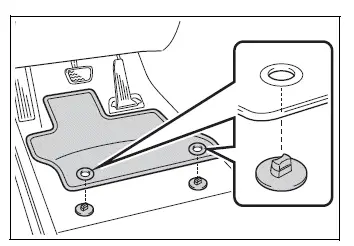
2. Turn the upper knob of each retaining hook (clip) to lock the floor mat securely in place. After fastening the clips, gently check the mat to confirm that it does not shift.
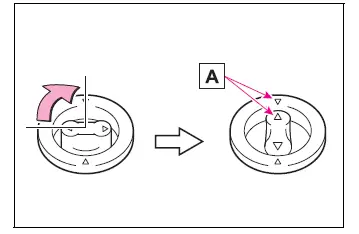
The shape and design of the retaining hooks (clips) may differ from those shown in the illustration, but the floor mat must always be attached using the securing points provided in the vehicle.
WARNING Observe the following precautions.
Failure to follow these precautions may allow the driver's floor mat to slip forward and interfere with pedal operation while driving. The accelerator pedal may remain depressed, or the brake pedal may not be able to travel through its full range, potentially causing unexpected acceleration or making the Toyota RAV4 difficult to stop.
This could lead to a collision or another serious accident, resulting in death or serious injury.
■ When installing the driver's floor mat
- Do not use floor mats designed for another vehicle model or a different model year, even if they are Toyota Genuine floor mats. A mat with a different shape or retaining-point layout may not fit securely.
- Use only a floor mat specifically designed for the driver's seat. Do not place a passenger-side or rear floor mat in the driver's footwell.
- Always secure the driver's floor mat with all of the retaining hooks (clips) provided. Confirm that every clip is fully engaged before driving.
- Do not stack two or more floor mats on top of one another, as the increased thickness may interfere with pedal movement.
- Do not install the floor mat bottom-side up, upside-down, or in any position other than its intended orientation.
■ Before driving
- Check that the driver's floor mat is securely fixed in the correct position with all provided retaining hooks (clips). Perform this inspection especially carefully after the mat has been removed or the vehicle floor has been cleaned.
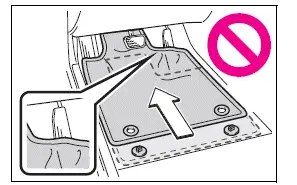
- With the engine stopped and the shift lever in P, fully depress each pedal to the floor and confirm that the pedal moves freely without touching, catching on, or becoming obstructed by the floor mat.
For safe driving Toyota RAV4 XA50
Before driving, adjust the seat, head restraint, steering position, and mirrors to provide a comfortable posture and a clear view around the vehicle. Correct preparation helps the driver operate the Toyota RAV4 safely and maintain proper control.
Correct driving posture
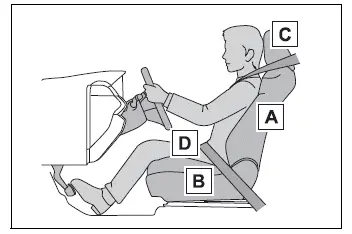
- Adjust the seatback angle so that you can sit upright with your back supported by the seat. You should be able to steer comfortably without leaning forward or stretching away from the seatback.
- Adjust the seat position so that you can fully depress each pedal while maintaining a slight bend in your knees. When holding the steering wheel, your arms should also remain slightly bent at the elbows.
- Adjust and lock the head restraint so that its center is positioned as close as possible to the level of the top of your ears. Confirm that the restraint is securely locked before driving.
- Fasten the seat belt correctly and make sure it is positioned securely across the shoulder and hips without being twisted.
WARNING Observe the following precautions.
Failure to follow these precautions may reduce the driver's ability to control the vehicle or limit the effectiveness of the occupant protection equipment, resulting in death or serious injury.
- Do not adjust the position of the driver's seat while driving. Sudden seat movement could cause the driver to operate the pedals or steering wheel incorrectly and lose control of the Toyota RAV4.
- Do not place a cushion between the driver or passenger and the seatback. A cushion may prevent the occupant from maintaining the correct posture and may reduce the effectiveness of the seat belt and head restraint during sudden braking or a collision.
- Do not place any objects under the front seats. Items stored in this area may become caught in the seat tracks and prevent the seat from locking securely. This may contribute to an accident and could also damage the seat adjustment mechanism.
- Always observe the applicable legal speed limit when driving on public roads. Select a speed that is also appropriate for traffic, weather, visibility, and road conditions.
- When traveling long distances, stop regularly and rest before fatigue begins to affect your concentration. If you feel tired, drowsy, or unable to focus while driving, do not force yourself to continue. Stop the Toyota RAV4 in a safe location and take a break immediately.
Correct use of the seat belts
Before driving, confirm that the driver and every passenger are wearing their seat belts correctly. Each occupant should use the seat belt provided for their seating position. A child must be secured in a child restraint system appropriate for the child's size and age until the child is large enough to wear the vehicle's seat belt properly.
Adjusting the mirrors
Adjust the inside rear view mirror, if equipped, the Digital Rear-view Mirror, if equipped, and both outside rear view mirrors so that you have a clear view behind and alongside the vehicle. Complete all mirror adjustments before driving and confirm that the selected positions minimize unnecessary blind areas without requiring you to move away from the correct driving posture.
Seat belts Toyota RAV4 fifth generation
Before driving the Toyota RAV4, make sure that the driver and every passenger are seated correctly and wearing their seat belts properly. Seat belts must remain fastened throughout the journey.
WARNING Observe the following precautions to reduce the risk of injury during sudden braking, abrupt steering, or a collision.
Failure to follow these precautions may result in death or serious injury.
■ Wearing a seat belt
- Make sure that every passenger wears the seat belt provided for their seating position before the vehicle begins moving.
- Always wear the seat belt correctly, ensuring that it is securely fastened and properly positioned against the body.
- Each seat belt is designed for use by one person only. Never secure two or more occupants with the same belt, including children.
- Toyota recommends that children travel in a rear seat and remain properly secured with a seat belt and/or a child restraint system appropriate for the child.
- To maintain an effective seating position, do not recline the seatback more than necessary. Seat belts provide the greatest protection when occupants sit upright and well back against their seats.
- Never route the shoulder belt under your arm, as this prevents it from restraining the upper body correctly.
- Position the lap portion of the seat belt low and snug across the hips, not across the abdomen.
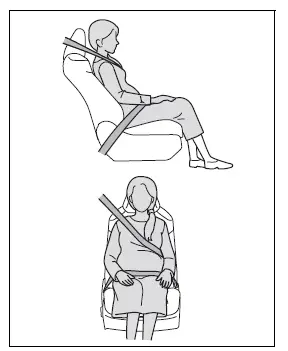
■ Pregnant women
Seek medical advice regarding seat belt use and follow the recommended method for wearing it correctly.
Pregnant women should position the lap belt as low as possible across the hips in the same manner as other occupants. The shoulder belt should extend fully over the shoulder and across the chest while avoiding contact with the rounded abdominal area.
If the seat belt is positioned incorrectly, sudden braking or a collision may expose both the pregnant woman and the fetus to death or serious injury.
■ People suffering illness
Anyone suffering from an illness or medical condition should obtain professional medical advice and wear the seat belt in the recommended manner. Do not change the routing or use of the belt without appropriate guidance.
■ Seat belt damage and wear
- Do not allow the seat belt webbing, latch plate, or buckle to become trapped or crushed in a door, as this may damage the restraint system.
- Inspect the seat belt system periodically for cuts, fraying, excessive wear, loose components, or other visible damage. Do not use a damaged seat belt until it has been replaced, because it may not protect the occupant effectively during sudden braking or a collision.
- Make sure that the latch plate locks securely into the buckle and that the belt lies flat without twists. If any seat belt in the Toyota RAV4 does not retract, fasten, release, or operate correctly, contact your Toyota dealer immediately.
- Replace the affected seat assembly, including its seat belts, if the vehicle has been involved in a serious accident, even when no damage is immediately visible.
- Do not attempt to install, remove, modify, disassemble, repair, or dispose of any seat belt component yourself. Have all necessary work performed by your Toyota dealer, as improper handling may prevent the restraint system from operating correctly.
Correct use of the seat belts Toyota RAV4 compact crossover
Correct seat belt positioning is essential for effective occupant protection. Before driving the Toyota RAV4, make sure each belt is securely fastened, lies flat against the body, and is adjusted as described below.
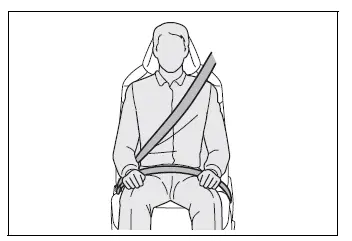
- Extend the shoulder belt so that it passes fully across the shoulder and chest. It should not press against the neck or slip away from the shoulder.
- Position the lap belt as low as possible across the hips rather than over the abdomen, and make sure it fits snugly against the body.
- Adjust the seatback to an appropriate upright position.
Sit straight and well back in the seat so that your back remains supported by the seatback.
- Make sure the seat belt webbing is not twisted, folded, or caught before fastening it.
■ Child seat belt usage
The seat belts installed in the Toyota RAV4 are primarily designed for occupants of adult size. Children must be secured according to their size until they can wear the vehicle's seat belt correctly without assistance.
- Use a child restraint system appropriate for the child's size and development until the child is large enough to wear the vehicle's seat belt properly.
- Once the child is large enough to use the vehicle's seat belt, follow all instructions regarding correct seating posture, belt routing, and proper fastening.
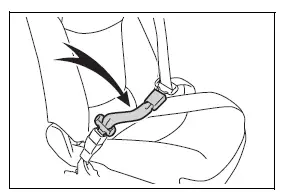
■ Seat belt extender
If a seat belt cannot be fastened securely because its standard length is insufficient, a personalized seat belt extender is available free of charge from your Toyota dealer. The extender must be selected specifically for the intended occupant, vehicle, and seating position.
WARNING
■ Using a seat belt extender
Observe the following precautions to reduce the risk of injury during sudden braking, abrupt steering, or a collision.
Failure to follow these precautions may result in death or serious injury.
- Do not use a seat belt extender when the standard seat belt can be fastened correctly without it. Unnecessary use may prevent the restraint from fitting securely.
- Do not use a seat belt extender when installing a child restraint system. The extended belt may not hold the child restraint securely, increasing the risk of death or serious injury in an accident.
- A personalized extender may not provide safe restraint when installed in another vehicle, used by another person, or attached at a seating position different from the one for which it was originally selected.
NOTICE
■ When using a seat belt extender
When releasing the seat belt, press the buckle release button on the extender rather than the release button on the vehicle's seat belt buckle.
This method helps prevent damage to the Toyota RAV4 interior, the original buckle, and the personalized extender.
Fastening and releasing the seat belt
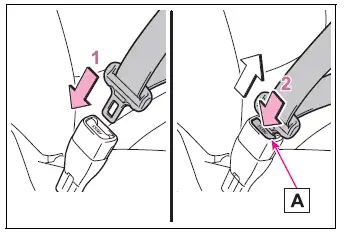
- To fasten the seat belt, insert the latch plate firmly into the buckle until a distinct click is heard. Gently pull the belt afterward to confirm that the plate is securely locked.
- To release the seat belt, press release button A and guide the belt as it retracts to prevent the latch plate from striking nearby interior surfaces.
■ Emergency locking retractor (ELR)
The emergency locking retractor allows normal movement while the seat belt is worn, but it locks the belt during a sudden stop or an impact. The mechanism may also engage if an occupant leans forward too quickly. Moving slowly and smoothly allows the belt to extend normally so the occupant can adjust position without activating the lock.
■ Automatic locking retractor (ALR)
When a passenger's shoulder belt is pulled out completely and then allowed to retract even slightly, the automatic locking retractor locks the belt at that length and prevents it from being extended again. This function is used to hold a child restraint system (CRS) firmly against the seat. To return the belt to normal operation, allow it to retract fully into the retractor, and then pull it out again as needed.
Adjusting the seat belt shoulder anchor height (front seats)
The shoulder anchor height can be adjusted so that the belt passes correctly across the center of the occupant's shoulder. Complete the adjustment while the Toyota RAV4 is stopped, and confirm that the anchor is securely locked before driving.
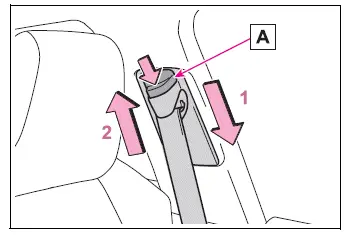
- To lower the seat belt shoulder anchor, press and hold release button A while moving the anchor downward to the required position.
- To raise the seat belt shoulder anchor, press and hold release button A while moving the anchor upward to the required position.
Move the height adjuster upward or downward until the shoulder belt is correctly positioned. Release the button and continue moving the anchor slightly until a click is heard, then check that it is securely locked.
WARNING
■ Adjustable shoulder anchor
Always make sure that the shoulder belt passes across the center of your shoulder. Keep the belt away from your neck while ensuring that it does not slip off the shoulder. Incorrect belt positioning may reduce occupant protection and could result in death or serious injury during sudden braking, abrupt steering, or a collision.
Seat belt pretensioners (front and outboard rear seats)
The seat belt pretensioners help restrain occupants quickly by retracting the belts when the Toyota RAV4 is subjected to certain types of severe frontal or side collisions or a vehicle rollover. This rapid tightening helps reduce forward or sideways occupant movement at the beginning of the impact.
The pretensioners are not designed to activate during a minor frontal impact, a minor side impact, or a rear impact. Whether activation occurs depends on the type and severity of the collision.
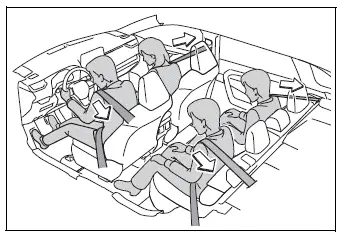
■ Replacing the belt after the pretensioner has been activated
If the vehicle is involved in multiple collisions, a pretensioner that activates during the first collision will not activate again during a second or subsequent collision. The affected seat belt assembly must therefore be inspected and replaced as required before the seating position is used again.
WARNING
■ Seat belt pretensioners
Observe the following precautions to reduce the risk of injury during sudden braking, abrupt steering, or a collision.
Failure to follow these precautions may result in death or serious injury.
- Do not place a cushion or any similar item on the front passenger's seat. Doing so may distribute the passenger's weight incorrectly and prevent the sensor from detecting the occupant properly. As a result, the front passenger seat belt pretensioner may not activate as intended during a collision.
- If a pretensioner has activated, the SRS warning light will illuminate. The affected seat belt cannot be reused and must be replaced by your Toyota dealer before the Toyota RAV4 is driven with an occupant in that seating position.
SRS airbags Toyota RAV4 (XA50)
The SRS airbags are designed to inflate when the Toyota RAV4 is subjected to certain types of severe impact that could cause significant injury to the occupants. Working together with correctly fastened seat belts, they help reduce the risk of death or serious injury by cushioning and restraining occupant movement during a collision.
SRS airbag system
■ Location of the SRS airbags
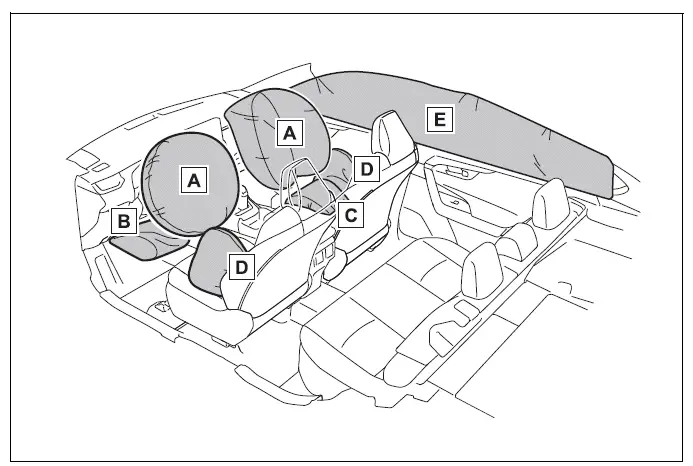
SRS front airbags
- SRS driver airbag/front passenger airbag
These airbags can help protect the head and chest of the driver and front passenger from impact with interior components during certain severe frontal collisions. - SRS knee airbag
This airbag can help provide additional protection for the driver by limiting lower-body movement during certain impacts. - SRS seat cushion airbag
This airbag can help restrain the front passenger and support the intended operation of the occupant protection system.
SRS side and curtain shield airbags
- SRS side airbags
These airbags can help protect the torso of the front seat occupants during certain severe side impacts. - SRS curtain shield airbags
- These airbags can help protect primarily the head of occupants seated in the outboard seating positions.
- They can also help reduce the possibility of occupants being thrown from the vehicle during a rollover.
■ SRS airbag system components
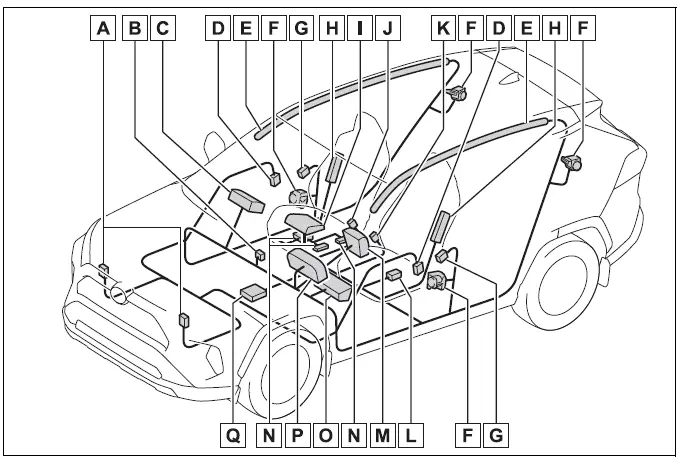
- Front impact sensors
- "AIR BAG ON" and "AIR BAG OFF" indicator lights
- Front passenger airbag
- Side impact sensors (front door)
- Curtain shield airbags
- Seat belt pretensioners and force limiters
- Side impact sensors (front)
- Side airbags
- Seat cushion airbag
- Front passenger's seat belt buckle switch
- Driver's seat belt buckle switch
- Driver's seat position sensor
- Driver airbag
- Front passenger occupant classification system (ECU and sensors)
- Knee airbag
- SRS warning light
- Airbag sensor assembly
The Toyota RAV4 is equipped with ADVANCED AIRBAGS designed in accordance with the applicable US motor vehicle safety standards (FMVSS 208). The airbag sensor assembly, or ECU, controls airbag deployment using information received from the sensors and other components shown in the system diagram above. This information includes the severity of the collision and relevant occupant data. When deployment is required, a chemical reaction inside the inflators rapidly fills the airbags with non-toxic gas, allowing them to help restrain occupant movement and reduce contact with parts of the vehicle interior.
■ If the SRS airbags deploy (inflate)
- Slight abrasions, burns, bruising, or similar injuries may occur because the SRS airbags deploy at extremely high speed and are inflated by hot gases.
- A loud noise will be heard, and white powder may be released into the cabin as the airbags inflate.
- Parts of the airbag modules, including the steering wheel hub, airbag covers, and inflators, as well as the front seats, sections of the front and rear pillars, and roof side rails, may remain hot for several minutes. The deployed airbags themselves may also be hot.
- The windshield may crack as a result of the collision or airbag deployment.
- The brakes and stop lights will be controlled automatically.
- The interior lights will illuminate automatically.
- The emergency flashers will activate automatically.
- The fuel supply to the engine will be stopped.
- For Safety Connect subscribers, if any of the situations listed below occurs, the system is designed to place an emergency call to the response center automatically without requiring the occupants to press the "SOS" button. The vehicle location is transmitted, and an agent will attempt to communicate with the occupants to determine the seriousness of the emergency and the assistance required. If the occupants cannot respond, the agent will treat the call as an emergency and help arrange the necessary emergency services.
- An SRS airbag in the Toyota RAV4 is deployed.
- A seat belt pretensioner is activated.
- The vehicle is involved in a severe rear-end collision.
■ SRS airbag deployment conditions (SRS front airbags)
- The SRS front airbags are designed to deploy when the force of a frontal impact exceeds the specified threshold level. This threshold corresponds approximately to a 12 - 18 mph [20 - 30 km/h] frontal collision with a fixed wall that does not move or deform on impact.
However, the collision speed required for deployment may be considerably higher in the following situations because part of the impact energy can be absorbed by movement, deformation, or the way the vehicles make contact:
- If the Toyota RAV4 strikes an object that can move or deform during impact, such as a parked vehicle or sign pole
- If the vehicle is involved in an underride collision, such as when the front of the vehicle travels underneath the bed of a truck
- Depending on the type, direction, and severity of the collision, only the seat belt pretensioners may activate while the SRS front airbags remain undeployed.
- The SRS front airbags for the front passenger are not designed to activate when no passenger is seated in the front passenger seat. However, they may deploy if luggage or another object is placed on the seat, even when the seating position is otherwise unoccupied.
- The SRS seat cushion airbag in the front passenger seat will not operate if the occupant is not wearing a seat belt.
■ SRS airbag deployment conditions (SRS side and curtain shield airbags)
- The SRS side and curtain shield airbags are designed to deploy when a side impact exceeds the specified threshold level. This threshold corresponds to the impact force produced by an approximately 3300 lb. [1500 kg] vehicle striking the passenger cabin from a direction perpendicular to the Toyota RAV4 at an approximate speed of 12 - 18 mph [20 - 30 km/h].
- Both SRS curtain shield airbags will deploy when a qualifying side collision occurs on either side of the vehicle.
- Both SRS curtain shield airbags will deploy if the vehicle rolls over.
- Both SRS curtain shield airbags may also deploy during a sufficiently severe frontal collision.
■ Conditions under which the SRS airbags may deploy (inflate), other than a collision
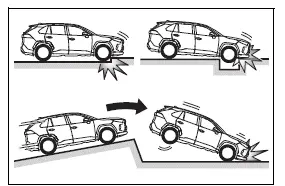
The SRS front airbags and SRS curtain shield airbags may also deploy when the underside of the vehicle is subjected to a severe impact, even if the event is not a conventional collision with another vehicle. Examples of these conditions are shown in the illustration.
- Striking a curb, the edge of the pavement, or another hard surface
- Dropping into or jumping over a deep hole
- Landing heavily or falling onto a lower surface
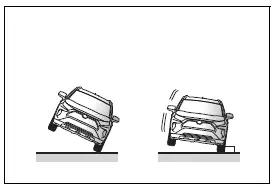
The SRS curtain shield airbags may also deploy under the vehicle movement and impact conditions illustrated below.
- The angle at which the vehicle begins to tip is marginal and does not develop into a complete rollover.
- The vehicle skids sideways and strikes a curbstone.
■ Types of collisions that may not deploy the SRS airbags (SRS front airbags)
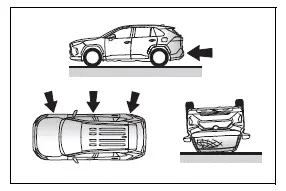
The SRS front airbags generally do not inflate during a side collision, rear collision, vehicle rollover, or low-speed frontal collision. However, deployment may still occur whenever an impact of any type produces sufficient forward deceleration of the vehicle.
- Collision from the side
- Collision from the rear
- Vehicle rollover
■ Types of collisions that may not deploy the SRS airbags (SRS side and curtain shield airbags)
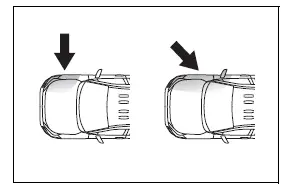
The SRS side and curtain shield airbags may not activate if the Toyota RAV4 is struck from the side at certain angles or if the impact occurs against an area of the vehicle body outside the passenger compartment. Deployment depends on the location, angle, and severity of the impact detected by the restraint system.
- Side collision affecting an area of the vehicle body other than the passenger compartment
- Side collision occurring at an angle
The SRS side airbags generally do not deploy when the Toyota RAV4 is involved in a frontal or rear collision, during a rollover, or in a low-speed side impact. Deployment depends on the direction, location, and severity of the force detected by the airbag sensors.
- Collision from the front
- Collision from the rear
- Vehicle rollover
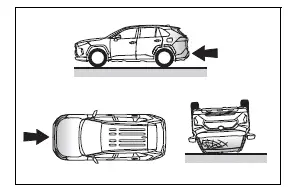
The SRS curtain shield airbags generally do not inflate during a rear collision, when the vehicle pitches end over end, or when it is involved in a low-speed side or frontal collision. However, actual deployment is determined by the impact characteristics detected by the restraint system.
- Collision from the rear
- Pitching end over end
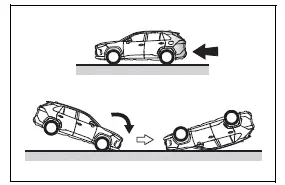
■ When to contact your Toyota dealer
In any of the following situations, the Toyota RAV4 may require professional inspection and/or repair, even when no airbag has deployed and the visible damage appears minor.
Contact your Toyota dealer as soon as possible and avoid modifying, touching, or attempting to repair any affected airbag-related component yourself.
- Any SRS airbag has inflated, regardless of the type or severity of the collision.
- The front of the vehicle is damaged or deformed, or the Toyota RAV4 has been involved in an accident that was not severe enough to deploy the SRS front airbags.
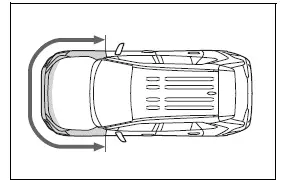
- A section of a door or the surrounding body area is damaged, deformed, punctured, or otherwise affected, or the vehicle has been involved in an accident that did not cause the SRS side and curtain shield airbags to deploy.
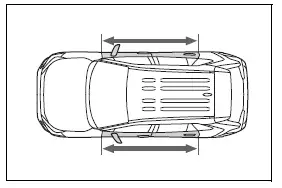
- The steering wheel pad, the dashboard area near the front passenger airbag, or the lower portion of the instrument panel is scratched, cracked, deformed, or otherwise damaged.
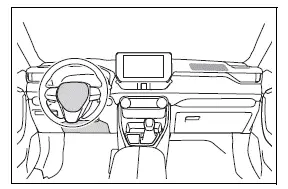
- The surface of the front passenger seat cushion is scratched, cracked, torn, or otherwise damaged near the seat cushion airbag area.
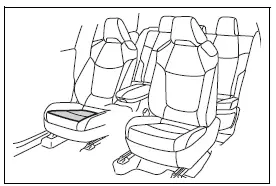
- The upholstery or surface of a seat containing an SRS side airbag is scratched, cracked, torn, or otherwise damaged.
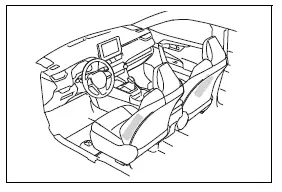
- The front pillar, rear pillar, or roof side rail garnish containing an SRS curtain shield airbag is scratched, cracked, loose, deformed, or otherwise damaged.
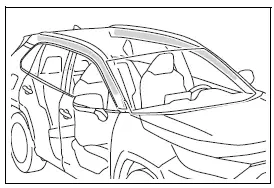
WARNING
■ SRS airbag precautions
Observe the following precautions regarding the SRS airbags and the seating positions of all occupants.
Failure to follow these precautions may reduce the effectiveness of the occupant protection system and could result in death or serious injury.
- The driver and every passenger in the vehicle must wear their seat belts correctly at all times. SRS airbags are supplemental restraint devices designed to work together with properly fastened seat belts, not replace them.
- The SRS driver airbag deploys with considerable force and may cause death or serious injury, especially when the driver is positioned too close to the airbag. The National Highway Traffic Safety Administration (NHTSA) provides the following guidance:
Because the highest-risk area for the driver's airbag is within the first 2 - 3 in. (50 - 75 mm) of inflation, maintaining a distance of approximately 10 in. (250 mm) between your breastbone and the center of the steering wheel provides a clear margin of safety.
If you currently sit less than 10 in. (250 mm) from the steering wheel, adjust your driving position using one or more of the following methods while preserving comfortable and complete control of the Toyota RAV4:
- Move the driver's seat rearward as far as practical while still allowing you to reach and fully operate the pedals comfortably.
- Slightly recline the seatback while maintaining an upright, supported posture and clear visibility of the road, instruments, and surrounding traffic.
Although vehicle designs and seating positions differ, many drivers can maintain the recommended 10 in. (250 mm) distance from the steering wheel even when the driver's seat is positioned far forward. Slightly reclining the seatback may provide additional clearance while preserving comfortable access to the controls. If reclining the seatback makes it difficult to see the road clearly, raise your seating position by adjusting the seat height, if this feature is available, or by using a firm, stable, and non-slip cushion.
- If the steering wheel is adjustable, tilt it downward so that the airbag is directed toward your chest rather than your head and neck. Make sure the steering wheel remains comfortable to operate and does not obstruct your view of the instrument panel.
Adjust the seat as recommended by NHTSA while ensuring that you can still operate the pedals and steering wheel correctly and maintain a clear view of the road, instrument panel, and vehicle controls.
- If a seat belt extender is inserted into a front seat belt buckle but is not connected to the seat belt latch plate, the SRS system may incorrectly determine that the driver or front passenger is wearing a seat belt. Under these conditions, the SRS front airbags may not operate correctly during a collision, increasing the risk of death or serious injury. When using an approved seat belt extender in the Toyota RAV4, always connect and wear the entire seat belt assembly properly.
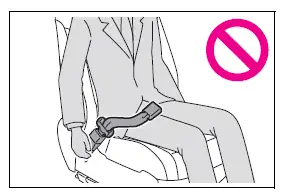
- The SRS front passenger airbag also deploys with considerable force and may cause death or serious injury, particularly if the passenger is seated too close to the dashboard. Move the front passenger seat as far away from the airbag as practical and adjust the seatback so that the passenger remains upright and well supported.
- Infants and children who are seated or restrained incorrectly may be killed or seriously injured by a deploying airbag. Any child who is too small to wear the vehicle's seat belt correctly must be secured in an appropriate child restraint system. Toyota strongly recommends seating all infants and children in the rear seats of the Toyota RAV4 with suitable restraints, as the rear seating positions are safer for them than the front passenger seat.
- Do not sit on the front edge of the seat or lean forward against the dashboard. Maintain an upright seating position with your back against the seatback.
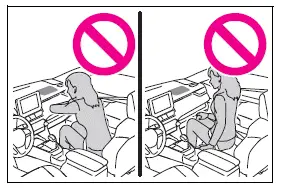
- Do not allow a child to stand in front of the SRS front passenger airbag unit or sit on the lap or knees of a front passenger. A deploying airbag can strike the child with severe force.
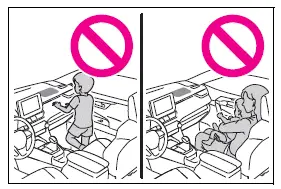
- Do not allow front seat occupants to hold luggage, electronic devices, or other objects on their knees, as these items may interfere with the restraint system or be propelled during airbag deployment.
- Do not lean your head, arms, or body against the door, roof side rail, or front, side, and rear pillars. These areas contain components associated with the side and curtain shield airbags.
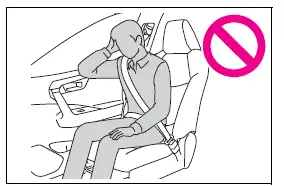
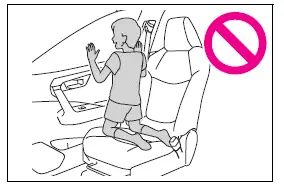
- Do not allow anyone to kneel on a passenger seat while facing the door or place their head, arms, or hands outside the vehicle. These positions greatly increase the risk of injury if a side or curtain shield airbag deploys.
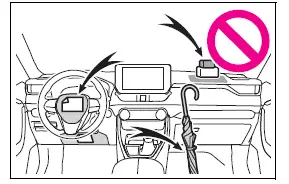
- Do not attach accessories to or lean objects against the dashboard, steering wheel pad, or lower portion of the instrument panel. These items may interfere with airbag deployment or become dangerous projectiles when the SRS driver, front passenger, or knee airbags inflate.
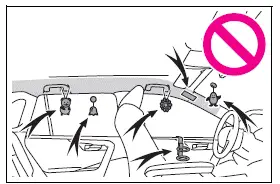
- Do not attach accessories or other objects to the doors, windshield, side windows, front or rear pillars, roof side rails, or assist grips. Such items may obstruct the curtain shield airbags or be thrown into the cabin when the airbags deploy.
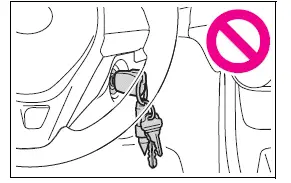
- Vehicles without a smart key system: Do not attach heavy, sharp, rigid, or bulky objects, including large key rings and accessories, to the ignition key. These objects may obstruct deployment of the SRS knee airbag or be propelled toward the driver's seating area by the force of inflation, creating a serious risk of injury.
- Do not hang coat hangers, heavy accessories, or other hard objects from the coat hooks. If the SRS curtain shield airbags deploy, these items may be thrown through the cabin and could cause death or serious injury.
- If a vinyl cover or protective film has been placed over the area where the SRS knee airbag deploys, remove it immediately. Covering this area may interfere with correct airbag inflation.
- Do not install seat covers, cushions, or other accessories that cover the areas from which the SRS side airbags or SRS seat cushion airbag deploy. Such accessories may obstruct inflation, prevent the airbags from operating correctly, disable part of the restraint system, or contribute to unintended deployment, resulting in death or serious injury.
- Do not strike, kick, drill into, or apply significant force to areas containing SRS airbag components or to the front doors. Impact or damage in these locations may cause the SRS airbags to malfunction or operate unexpectedly.
- Do not touch the airbag modules, covers, inflators, or surrounding components immediately after the SRS airbags have deployed, as these parts may remain extremely hot and could cause burns.
- If breathing becomes difficult after airbag deployment, open a door or window to allow fresh air into the Toyota RAV4, or leave the vehicle when it is safe to do so. Wash any powder or residue from exposed skin as soon as possible to help prevent irritation.
- If an area containing an SRS airbag, including the steering wheel pad or the front and rear pillar garnishes, becomes cracked, deformed, scratched, or otherwise damaged, have it inspected and replaced by your Toyota dealer.
- Do not place a cushion, thick cover, luggage, or any similar object on the front passenger seat. Doing so may distribute weight incorrectly and prevent the occupant detection sensors from identifying the passenger accurately. As a result, the SRS front passenger airbags may not deploy as intended during a collision.
■ Modification and disposal of SRS airbag system components
Do not dispose of the Toyota RAV4 or perform any of the modifications listed below without first consulting your Toyota dealer. Improper work may damage the SRS airbag system, prevent correct deployment, or cause an airbag to inflate unexpectedly, resulting in death or serious injury.
- Installing, removing, disassembling, modifying, or repairing any SRS airbag or related component
- Repairing, modifying, removing, or replacing the steering wheel, instrument panel, dashboard, seats, seat upholstery, front, side, or rear pillars, roof side rails, front door panels, front door trims, or front door speakers
- Modifying a front door panel, including drilling, cutting, or making a hole in it
- Repairing or modifying the front fenders, front bumper, or either side of the occupant compartment
- Installing a grille guard, bull bar, kangaroo bar, snow plow, winch, roof luggage carrier, or similar exterior equipment
- Making modifications to the vehicle's suspension system that may affect impact detection or vehicle behavior
- Installing electronic equipment such as mobile two-way radios, CD players, or other devices that may interfere with the vehicle's electrical systems
- Modifying the vehicle to accommodate a person with a physical disability without professional guidance from your Toyota dealer
Front passenger occupant classification system Toyota RAV4 XA50
The Toyota RAV4 is equipped with a front passenger occupant classification system. This system evaluates the condition of the front passenger seat and determines whether the front passenger airbag and front passenger seat cushion airbag should be activated or deactivated.
System components
The indicator lights and warning functions shown below allow the driver to check the current operating status of the occupant classification and restraint systems.
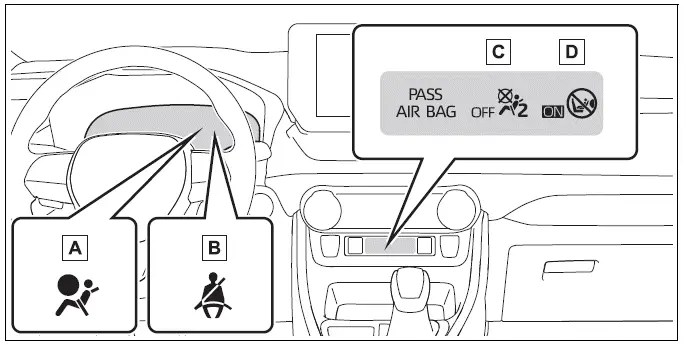
- SRS warning light
- Driver's and front passenger's seat belt reminder light
- "AIR BAG OFF" indicator light
- "AIR BAG ON" indicator light
WARNING
■ Front passenger occupant classification system precautions
Observe the following precautions to ensure that the front passenger occupant classification system can evaluate the seat conditions correctly.
Failure to follow these precautions may prevent the airbags from operating as intended and could result in death or serious injury.
- Always wear the seat belt correctly and make sure it lies properly across the occupant's body.
- Before anyone sits in the front passenger seat, make sure that the front passenger seat belt latch plate has not been left inserted in the buckle.
- When using a seat belt extender for the front passenger seat, confirm that the "AIR BAG OFF" indicator light is not illuminated. If the "AIR BAG OFF" indicator is illuminated, disconnect the extender tongue from the seat belt buckle and reconnect the standard seat belt. After confirming that the "AIR BAG ON" indicator light is illuminated, reconnect the seat belt extender correctly. Using the extender while the "AIR BAG OFF" indicator remains illuminated may prevent the front passenger SRS airbags from deploying during a collision, resulting in death or serious injury.
- Do not place a heavy load on the front passenger seat or on equipment connected to the seat, such as the seatback pocket.
- Do not place additional weight on the front passenger seat by resting your hands or feet against the front passenger seatback from the rear seating area.
- Do not allow a rear passenger to lift the front passenger seat with their feet or press strongly against the seatback with their legs.
- Do not place luggage, tools, or other objects underneath the front passenger seat, as they may affect the seat or system components.
-
Do not recline the front passenger seatback far enough for it to touch a rear seat. Contact between the seats may cause the "AIR BAG OFF" indicator light to illuminate, indicating that the front passenger SRS airbags will not deploy during a severe collision. If the seatback touches the rear seat, return it to a position where there is sufficient clearance.
Keep the front passenger seatback as upright as practical while the Toyota RAV4 is moving.
Excessive reclining may also reduce the effectiveness of the seat belt restraint system.
-
When an adult occupies the front passenger seat, the "AIR BAG ON" indicator light should illuminate. If the "AIR BAG OFF" indicator remains illuminated, ask the passenger to sit upright and well back in the seat, place both feet on the floor, and wear the seat belt correctly.
If the "AIR BAG OFF" indicator still remains illuminated, ask the passenger to move to a rear seat. If this is not possible, move the front passenger seat fully rearward while maintaining a proper seating position.
- If installing a forward-facing child restraint system on the front passenger seat is unavoidable, install and secure the restraint in the correct sequence according to the provided instructions.
- Do not modify, disassemble, or remove either of the front seats.
- Do not kick the front passenger seat or subject it to a severe impact. Doing so may cause the SRS warning light to illuminate, indicating a possible malfunction in the front passenger occupant classification system. Contact your Toyota dealer immediately if this occurs.
- Make sure that a child restraint system installed on a rear seat does not press against or contact either front seatback.
- Do not use cushions, thick seat covers, or other accessories that cover the surface of the front passenger seat cushion, as they may interfere with occupant detection.
- Do not modify or replace the upholstery of the front seats without consulting your Toyota dealer.
- Adjust the front passenger seat so that the head restraint does not contact the ceiling. If the head restraint remains pressed against the ceiling, the system may not identify the front passenger correctly, which could lead to improper airbag operation.
Condition and operation in the front passenger occupant classification system
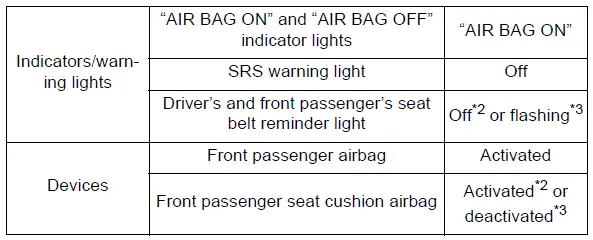
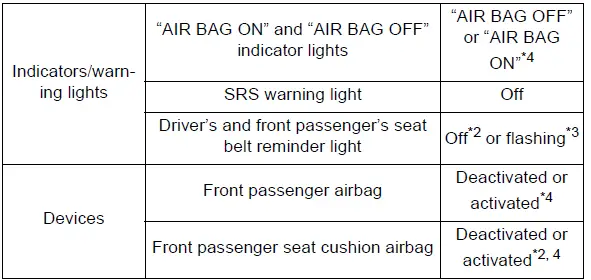
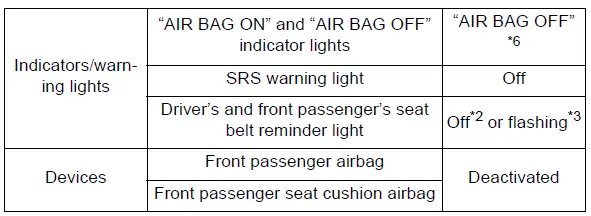
The following illustrations show how the indicator lights and restraint components may operate under different front passenger seat conditions in the Toyota RAV4.
■ Adult*1
■ Child*4
■ Child restraint system with infant*5
■ Unoccupied
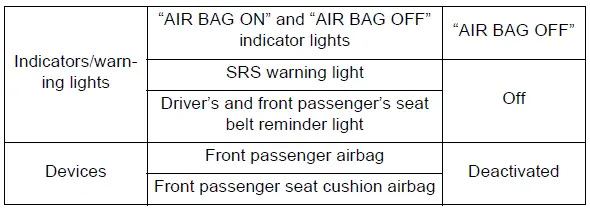
■ There is a malfunction in the system
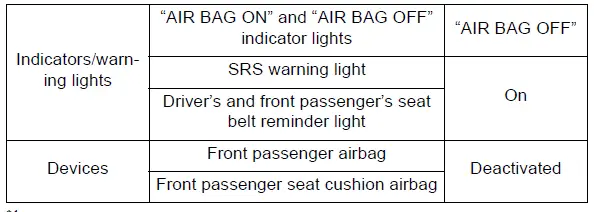
*1: The system generally identifies a person of adult size as an adult. However, a smaller adult seated in the front passenger seat may not be recognized as an adult, depending on the person's physique and seating posture.
*2: When the front passenger is wearing a seat belt.
*3: When the front passenger is not wearing a seat belt.
*4: The system may not recognize some occupants as children, including a child seated directly on the seat, in a booster seat, or in a convertible seat. Recognition may be affected by the child's physique or posture.
*5: Never install a rear-facing child restraint system on the front passenger seat. A forward-facing child restraint system should be installed on the front passenger seat only when doing so is unavoidable.
*6: If the applicable indicator light is not illuminated, refer to the child restraint system instructions in this manual and confirm that the restraint has been installed correctly.
Exhaust gas precautions Toyota RAV4
Vehicle exhaust contains substances that can be extremely harmful to the human body if inhaled. Always take appropriate precautions to prevent exhaust gases from entering the Toyota RAV4 cabin.
WARNING Exhaust gases contain carbon monoxide (CO), a dangerous gas that is both colorless and odorless. Observe the following precautions whenever the engine is running.
Failure to follow these precautions may allow exhaust gases to enter the vehicle. Carbon monoxide exposure can cause dizziness, loss of concentration, or unconsciousness, potentially leading to an accident, death, or a serious health hazard.
■ Important points while driving
- Keep the back door fully closed while driving. An open or partially closed back door may allow exhaust gases to be drawn into the passenger compartment.
- If you notice an exhaust odor inside the Toyota RAV4 even though the back door is closed, open the side windows immediately to ventilate the cabin and have the vehicle inspected by your Toyota dealer as soon as possible.
■ When parking
- Turn off the engine whenever the vehicle is parked in a poorly ventilated or enclosed area, such as a garage. Never rely on an open garage door to provide adequate ventilation.
- Do not leave the vehicle parked with the engine running for an extended period.
If idling cannot be avoided, move the Toyota RAV4 to a fully open area and make sure that exhaust fumes cannot enter the cabin through the windows, doors, or ventilation system.
- Do not leave the engine running where snow has accumulated or while heavy snow is falling. Snowbanks forming around the vehicle, especially near the exhaust outlet, may trap exhaust gases and allow them to enter the passenger compartment.
■ Exhaust pipe
The exhaust system should be inspected periodically. If you notice corrosion, a hole or crack, damage around a joint, or an unusual exhaust sound, have the Toyota RAV4 inspected and repaired by your Toyota dealer without delay. Do not continue driving if exhaust gases may be entering the cabin.