Toyota RAV4: Driving - Driving tips
Winter driving tips Toyota RAV4 XA50
Complete all necessary preparations and inspections before operating the Toyota RAV4 in winter conditions. Snow, ice, low temperatures, and reduced visibility can significantly affect traction and vehicle response, so always adjust your driving style to the prevailing weather and road conditions.
Pre-winter preparations
- Use fluids that are suitable for the expected outside temperatures throughout the winter season.
- Engine oil of the appropriate specification and viscosity
- Engine coolant with adequate protection for low temperatures
- Washer fluid formulated for freezing weather
- Have a qualified service technician inspect the condition and charge level of the battery, as cold temperatures can reduce battery performance.
- Install four appropriate snow tires on the vehicle or obtain a compatible set of tire chains for the front tires.*
Make sure that all four tires are the same specified size and brand. Any tire chains used on the Toyota RAV4 must also match the installed tire size and be fitted correctly.
*: Tire chains cannot be installed on vehicles equipped with 235/55R19 tires.
WARNING
■ Driving with snow tires
Observe the following precautions whenever snow tires are installed to help reduce the risk of an accident.
Failure to follow these requirements may result in loss of vehicle control, potentially causing death or serious injury.
- Use snow tires of the specified size for the vehicle.
- Maintain each tire at the recommended inflation pressure.
- Do not drive faster than 75 mph (120 km/h), regardless of the speed capability or type of snow tires installed.
- Install snow tires on all four wheels rather than on only some of the wheels.
■ Driving with tire chains (except vehicles with 235/55R19 tires)
Observe the following precautions when tire chains are installed to reduce the possibility of an accident.
Failure to follow these instructions may prevent the Toyota RAV4 from being driven safely and could result in death or serious injury.
- Do not exceed the speed limit specified by the tire-chain manufacturer or 30 mph (50 km/h), whichever speed is lower.
- Avoid rough or uneven road surfaces, raised sections, and potholes that could damage the chains, tires, or vehicle.
- Avoid rapid acceleration, abrupt steering, sudden braking, and shift operations that cause strong or unexpected engine braking.
- Reduce speed sufficiently before entering a curve so that stable vehicle control can be maintained throughout the turn.
- Do not use the LTA (Lane Tracing Assist) system while tire chains are installed.
NOTICE
■ Repairing or replacing snow tires on vehicles equipped with a tire pressure warning system
Have snow tires repaired, removed, or replaced by your Toyota dealer or a qualified tire retailer familiar with tire pressure warning systems.
Removing and reinstalling the tires can affect the tire pressure warning valves and transmitters, so the work must be performed carefully to preserve correct system operation.
Before driving the vehicle
Carry out the following preparations according to the temperature, snowfall, ice accumulation, and other winter driving conditions:
- Do not force open a frozen window or attempt to move a wiper blade that is stuck to the glass. Pour warm water over the frozen area to melt the ice, then wipe away the water immediately so that it does not freeze again.
- Remove any snow accumulated around the air inlet vents in front of the windshield to help ensure proper airflow and reliable operation of the climate control system fan.
- Inspect and remove excessive snow or ice from the exterior lights, outside rear-view mirrors, windows, roof, chassis, areas around the tires, and brake components before driving the Toyota RAV4.
- Remove snow, ice, and mud from the soles of your shoes before entering the vehicle so that your feet do not slip while operating the pedals.
When driving the vehicle
Accelerate gradually, maintain a greater following distance from the vehicle ahead, avoid sudden steering or braking, and travel at a reduced speed appropriate for the available traction and visibility.
When parking the vehicle
- Turn off the automatic operating mode of the parking brake before parking in freezing conditions. Otherwise, the parking brake may freeze and may not release automatically.
Also avoid using the following function, as it may cause the parking brake to operate automatically even when the parking brake automatic mode has been turned off:
- Brake hold system
- Park the Toyota RAV4 and move the shift lever to P without applying the parking brake when freezing of the brake mechanism is a concern. A frozen parking brake may be difficult or impossible to release.
If the vehicle is parked without applying the parking brake, securely block the wheels. Failure to chock the wheels may allow the vehicle to move unexpectedly and could result in an accident.
- When the parking brake is operating in automatic mode, release the parking brake after moving the shift lever to P.
- If the vehicle is parked without applying the parking brake, confirm that the shift lever cannot be moved out of P.
- If the vehicle is left parked in low temperatures while the brakes are wet, moisture on the brake components may freeze and interfere with normal brake operation.
WARNING
■ When parking the vehicle
When parking the Toyota RAV4 without applying the parking brake, always chock the wheels securely. If the wheels are not blocked, the vehicle may move unexpectedly, potentially resulting in an accident, death, or serious injury.
Selecting tire chains Toyota RAV4 2026
Vehicles without 235/55R19 tires
Always select tire chains of the correct size and specification for the tires installed on the Toyota RAV4. Using chains that do not fit properly may affect vehicle control or damage the tires and surrounding components.
Tire-chain dimensions are regulated according to tire size. Confirm that the selected chains match the installed tires before beginning installation.
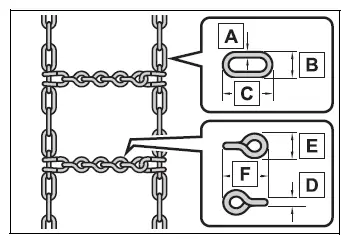
Side chain dimensions:
- 0.12 in. (3 mm) in diameter
- 0.39 in. (10 mm) in width
- 1.18 in. (30 mm) in length
Cross chain dimensions:
- 0.16 in. (4 mm) in diameter
- 0.55 in. (14 mm) in width
- 0.98 in. (25 mm) in length
Vehicles with 235/55R19 tires
Tire chains cannot be installed on vehicles equipped with 235/55R19 tires because adequate clearance is not available for their use.
Use suitable snow tires instead when additional traction is required for winter driving conditions.
Regulations on the use of tire chains (except 235/55R19 tires)
Requirements governing the installation and use of tire chains vary depending on the region, local authority, and type of road being traveled.
Always review and follow all applicable local regulations before installing tire chains on the Toyota RAV4 or driving onto a road where chain restrictions are in effect.
■ Tire chain installation
Observe the following precautions when installing, adjusting, or removing tire chains:
- Stop the vehicle in a safe location away from moving traffic before installing or removing the tire chains.
- Install tire chains on the front tires only. Do not fit tire chains to the rear tires.
- Install the chains on both front tires as tightly and evenly as possible. Stop and retighten them after driving approximately 1/4 to 1/2 mile (0.5 to 1.0 km).
- Follow the installation, tightening, speed, and usage instructions supplied by the tire-chain manufacturer.
NOTICE
■ Fitting tire chains on vehicles with a tire pressure warning system
The tire pressure warning valves and transmitters may not operate correctly while tire chains are installed. Continue to monitor tire condition carefully and remove the chains when they are no longer required.
Utility vehicle precautions Toyota RAV4 fifth generation
The Toyota RAV4 belongs to the utility vehicle class and is designed with greater ground clearance and a relatively narrower track in relation to the height of its center of gravity. These characteristics allow the vehicle to perform effectively in a wide range of on-road and off-road driving conditions, but they also affect handling and stability.
Utility vehicle features
- The specific design characteristics of a utility vehicle give it a higher center of gravity than an ordinary passenger car. Because of this structural difference, this type of vehicle is more susceptible to rollover, and utility vehicles have a significantly higher rollover rate than conventional passenger vehicles.
- One advantage of increased ground clearance is an elevated driving position that provides a clearer view of the road ahead, helping the driver identify changing conditions and anticipate potential hazards earlier.
- The Toyota RAV4 is not designed to negotiate corners at the same speeds as a lower passenger car, just as a low-slung sports car is not intended to provide satisfactory performance in demanding off-road conditions. Entering sharp turns at excessive speed may cause loss of control or a vehicle rollover.
WARNING
■ Utility vehicle precautions
Always observe the following precautions to reduce the risk of death, serious injury, or damage to the vehicle:
- During a rollover collision, an occupant who is not wearing a seat belt is significantly more likely to be killed than an occupant who is properly restrained. The driver and every passenger must always fasten their seat belts before the vehicle begins moving.
- Avoid sharp turns, sudden steering inputs, and other abrupt maneuvers whenever possible.
Improper operation of the Toyota RAV4 may lead to loss of vehicle control or a rollover, potentially resulting in death or serious injury.
- Placing cargo on the roof luggage carrier, if equipped, raises the vehicle’s center of gravity. When carrying a roof load, avoid high speeds, rapid starts, sharp turns, sudden braking, and abrupt maneuvers. Failure to drive appropriately may result in loss of control or a vehicle rollover.
- Always reduce speed when driving in strong or gusty crosswinds. Because of its body profile and higher center of gravity, the Toyota RAV4 is more sensitive to side winds than an ordinary passenger car. Slowing down provides more time to respond and helps maintain stable control.
- Do not drive horizontally across a steep slope. Whenever conditions permit, travel straight up or straight down the slope instead.
The Toyota RAV4, like other vehicles with similar off-road characteristics, can tip sideways more easily than it can roll forward or backward.
Off-road driving
When driving off-road, observe the following precautions to help ensure a safe and enjoyable experience while also protecting natural areas and preventing the closure of routes to off-road vehicles:
- Operate the vehicle only in locations where off-road vehicle travel is legally permitted.
- Respect private property and obtain the owner’s permission before entering or crossing privately owned land.
- Do not enter restricted or closed areas. Follow all gates, barriers, warning notices, and posted signs that limit or prohibit vehicle access.
- Remain on established roads and designated trails whenever possible.
When surfaces are wet, adjust your driving technique, reduce speed, or postpone travel to avoid damaging roads, trails, and the surrounding terrain.
■ Additional information for off-road driving
For owners in the U.S. mainland, Hawaii, and Puerto Rico:
For additional guidance about operating the Toyota RAV4 off-road, including permitted routes, local restrictions, and responsible land use, consult the following organizations:
- State and local parks and recreation departments
- State motor vehicle bureaus
- Recreational vehicle clubs and recognized off-road organizations
- The U.S. Forest Service and Bureau of Land Management
WARNING
■ Off-road driving precautions
Always observe the following precautions to reduce the risk of death, serious injury, or damage to your vehicle:
- Drive cautiously whenever the Toyota RAV4 is operated away from paved roads. Do not take unnecessary risks by entering dangerous terrain or attempting to cross areas that exceed the vehicle’s capabilities.
- Do not hold the steering wheel by its spokes while driving off-road. A severe bump may cause the steering wheel to turn suddenly and injure your hands. Keep both hands firmly on the outside of the steering wheel rim, with your thumbs positioned outside the rim.
- Immediately after driving through sand, mud, water, or snow, check that the brakes operate effectively before continuing at normal speed.
- After traveling through tall grass, mud, rocks, sand, rivers, or similar terrain, inspect the underbody for grass, branches, paper, cloth, stones, sand, or other material that may be attached or trapped underneath the vehicle. Remove all accumulated debris before continuing to operate the Toyota RAV4. Driving with combustible or obstructive material caught under the vehicle may cause a malfunction, component damage, or fire.
- When driving off-road or across rugged terrain, do not travel at excessive speed, jump the vehicle, make sudden turns, or intentionally strike rocks, embankments, or other obstacles.
Such actions may cause loss of control or a vehicle rollover, potentially resulting in death or serious injury. They may also cause costly damage to the suspension, chassis, tires, and underbody components.
NOTICE
■ To prevent water damage
Take all necessary precautions to prevent water from entering the engine, drivetrain, or other vehicle components. Water intrusion can cause severe and permanent mechanical damage.
- Water entering the engine air intake can cause severe engine damage and may prevent the engine from operating.
- Water entering the automatic transmission may reduce shift quality, cause the transmission to lock while producing vibration, and eventually result in serious internal damage.
- Water can remove grease from the wheel bearings, leading to corrosion and premature bearing failure. It may also enter the differentials, transmission, and transfer case on AWD models, reducing the lubricating performance of the gear oil and increasing component wear.
■ When driving through water
Before driving through water, including when crossing a shallow stream, check the water depth and confirm that the bottom is firm enough to support the vehicle. Proceed slowly, maintain a steady path, and avoid deep water that could reach the air intake or other vulnerable components of the Toyota RAV4.
■ Inspection after off-road driving
- Sand and mud accumulated around the brake discs may reduce braking effectiveness and can damage brake system components. Clean and inspect the affected areas before returning to regular road driving.
- Perform a maintenance inspection after every day of off-road driving through rough terrain, sand, mud, or water. Check the underbody, brakes, tires, suspension, and other exposed components for damage or accumulated debris. For scheduled maintenance requirements, refer to the “Scheduled Maintenance Guide” or the “Owner’s Manual Supplement.”